Question 5
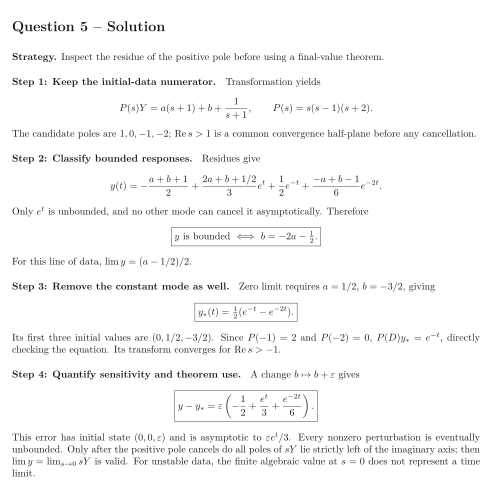
An unstable homogeneous mode may or may not appear in a forced response. For real parameters , consider
Tasks
Derive and identify all candidate poles before cancellation.
Find the necessary and sufficient relation between for a bounded response. Give a complete inverse transform that proves both necessity and sufficiency.
Among the bounded responses, find the unique initial pair for which . Compute that solution and verify its equation and initial data.
An experiment perturbs only from this special pair to . Find the exact response error. Explain how an arbitrarily small nonzero error can invalidate boundedness, and state precisely when a final-value calculation is justified.
Show solutionHide solution
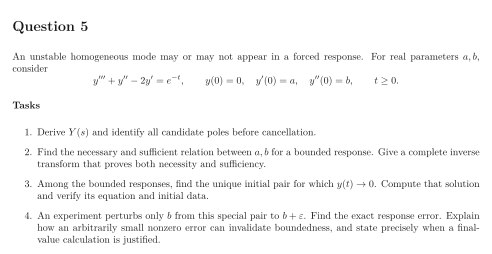
Question 5 – Solution
Strategy. Inspect the residue of the positive pole before using a final-value theorem.
Step 1: Keep the initial-data numerator. Transformation yields The candidate poles are ; is a common convergence half-plane before any cancellation.
Step 2: Classify bounded responses. Residues give Only is unbounded, and no other mode can cancel it asymptotically. Therefore For this line of data, .
Step 3: Remove the constant mode as well. Zero limit requires , , giving Its first three initial values are . Since and , , directly checking the equation. Its transform converges for .
Step 4: Quantify sensitivity and theorem use. A change gives This error has initial state and is asymptotic to . Every nonzero perturbation is eventually unbounded. Only after the positive pole cancels do all poles of lie strictly left of the imaginary axis; then is valid. For unstable data, the finite algebraic value at does not represent a time limit.