Question 8
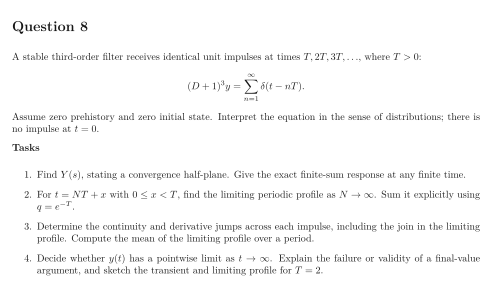
A stable third-order filter receives identical unit impulses at times , where : Assume zero prehistory and zero initial state. Interpret the equation in the sense of distributions; there is no impulse at .
Tasks
Find , stating a convergence half-plane. Give the exact finite-sum response at any finite time.
For with , find the limiting periodic profile as . Sum it explicitly using .
Determine the continuity and derivative jumps across each impulse, including the join in the limiting profile. Compute the mean of the limiting profile over a period.
Decide whether has a pointwise limit as . Explain the failure or validity of a final-value argument, and sketch the transient and limiting profile for .
Show solutionHide solution
Question 8 – Solution
Strategy. Sum delayed impulse kernels and distinguish a periodic limiting profile from a constant final value.
Step 1: Sum the transformed impulses. For , The sum is empty before ; including the current impulse adds .
Step 2: Sum the limiting profile. At the sum is . Geometric-series identities give The omitted tail is uniformly for and fixed , so uniformly on a period.
Step 3: Check joins and mean. Since , are continuous and jumps upward by one. Reindexing the convergent profile series gives the same periodic joins: , , . Also , so its mean is .
Step 4: Reject a constant final value. The profile is nonconstant: on each open gap , so a constant profile would be zero, contradicting its integral. Distinct phases therefore have distinct subsequential limits. Poles at , , remain in ; the formal limit is a mean, not a final value.
See the diagram in the original worksheet below.
