Question 9
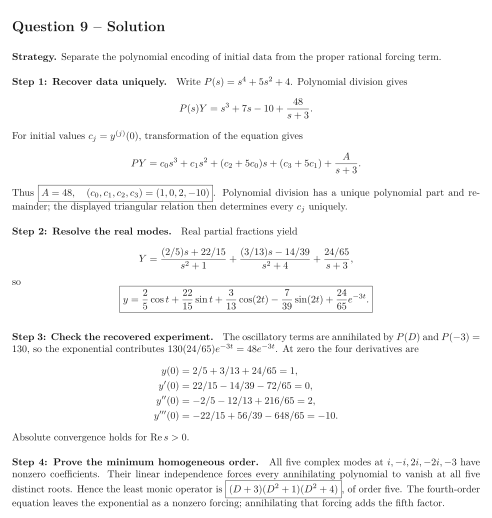
An experiment supplies the exact transform of a solution to The forcing amplitude and all four initial values are unknown real numbers.
Tasks
Recover and by polynomial division of . Prove that this recovery is unique.
Invert completely using real sine, cosine and exponential terms.
Verify the recovered forcing and all four initial values directly from your answer, and state an absolute-convergence half-plane.
Find the monic constant-coefficient homogeneous differential operator of least order that annihilates this particular response. Explain why its order differs from that of the forced equation, and prove minimality.
Show solutionHide solution
Question 9 – Solution
Strategy. Separate the polynomial encoding of initial data from the proper rational forcing term.
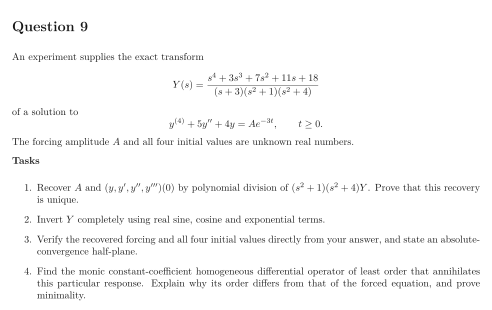
Step 1: Recover data uniquely. Write . Polynomial division gives For initial values , transformation of the equation gives Thus . Polynomial division has a unique polynomial part and remainder; the displayed triangular relation then determines every uniquely.
Step 2: Resolve the real modes. Real partial fractions yield so
Step 3: Check the recovered experiment. The oscillatory terms are annihilated by and , so the exponential contributes . At zero the four derivatives are Absolute convergence holds for .
Step 4: Prove the minimum homogeneous order. All five complex modes at have nonzero coefficients. Their linear independence forces every annihilating polynomial to vanish at all five distinct roots. Hence the least monic operator is , of order five. The fourth-order equation leaves the exponential as a nonzero forcing; annihilating that forcing adds the fifth factor.