Laplace Transforms — Question 10

PDF ↗

Question 10

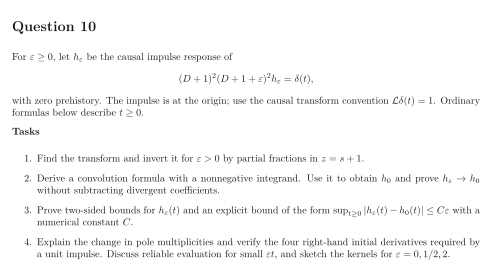
For ε≥0\varepsilon\geq 0, let hεh_\varepsilon be the causal impulse response of (D+1)2(D+1+ε)2hε=δ(t),(D+1)^2(D+1+\varepsilon)^2 h_\varepsilon=\delta(t), with zero prehistory. The impulse is at the origin; use the causal transform convention ℒδ(t)=1\mathcal L\delta(t)=1. Ordinary formulas below describe t≥0t\geq 0.

Tasks

  1. Find the transform and invert it for ε>0\varepsilon>0 by partial fractions in z=s+1z=s+1.

  2. Derive a convolution formula with a nonnegative integrand. Use it to obtain h0h_0 and prove hε→h0h_\varepsilon\to h_0 without subtracting divergent coefficients.

  3. Prove two-sided bounds for hε(t)h_\varepsilon(t) and an explicit bound of the form sup⁡t≥0|hε(t)−h0(t)|≤Cε\sup_{t\geq 0}|h_\varepsilon(t)-h_0(t)|\leq C\varepsilon with a numerical constant CC.

  4. Explain the change in pole multiplicities and verify the four right-hand initial derivatives required by a unit impulse. Discuss reliable evaluation for small εt\varepsilon t, and sketch the kernels for ε=0,1/2,2\varepsilon=0,1/2,2.

Original worksheet page 1: question and worked solution for 7-5-010
Show solutionHide solution

Question 10 – Solution

Strategy. Use partial fractions for a closed form and convolution for a stable coalescing-pole limit.

Step 1: Invert distinct repeated poles. For ε>0\varepsilon>0, Hε=1/[z2(z+ε)2]H_\varepsilon=1/[z^2(z+\varepsilon)^2] and Hε=1ε2(1z2+1(z+ε)2)+2ε3(1z+ε−1z).H_\varepsilon=\frac 1{\varepsilon^2}\left(\frac 1{z^2}+\frac 1{(z+\varepsilon)^2}\right) +\frac 2{\varepsilon^3}\left(\frac 1{z+\varepsilon}-\frac 1z\right). Hence hε=e−t{t(1+e−εt)/ε2−2(1−e−εt)/ε3}h_\varepsilon=e^{-t}\{t(1+e^{-\varepsilon t})/\varepsilon^2 -2(1-e^{-\varepsilon t})/\varepsilon^3\}.

Step 2: Take the limit through convolution. Convolving te−tte^{-t} with te−(1+ε)tte^{-(1+\varepsilon)t} gives hε(t)=e−t∫0tv(t−v)e−εvdv,h0(t)=t3e−t6.\boxed{h_\varepsilon(t)=e^{-t}\int_0^t v(t-v)e^{-\varepsilon v}\,dv,\qquad h_0(t)=\frac{t^3e^{-t}}6.} For fixed tt, dominated convergence justifies the limit, including t=0t=0.

Step 3: Prove global error bounds. Bounding the integrand and using 1−e−εv≤εv1-e^{-\varepsilon v}\leq\varepsilon v yields e−(1+ε)tt36≤hε(t)≤e−tt36,0≤h0−hε≤εt4e−t12.e^{-(1+\varepsilon)t}\frac{t^3}6\leq h_\varepsilon(t)\leq e^{-t}\frac{t^3}6, \qquad 0\leq h_0-h_\varepsilon\leq\frac{\varepsilon t^4e^{-t}}{12}. The maximum of t4e−tt^4e^{-t} is 256e−4256e^{-4} at t=4t=4. Thus sup⁡t≥0|hε−h0|≤64ε/(3e4)\boxed{\sup_{t\geq 0}|h_\varepsilon-h_0|\leq 64\varepsilon/(3e^4)}.

Step 4: Check poles, impulses and evaluation. Two double poles merge into a quadruple pole at −1-1; absolute convergence holds for Re⁡s>−1\operatorname{Re}s>-1. Convolution gives hε=t3/6+O(t4)h_\varepsilon=t^3/6+O(t^4), so its right-hand jet is (0,0,0,1)(0,0,0,1), producing exactly a unit δ\delta. For small εt\varepsilon t, use the integral or its exponential series; the closed form subtracts large nearly equal terms and can lose significant digits.

See the diagram in the original worksheet below.

Original worksheet page 2: question and worked solution for 7-5-010

Original worksheet layout. Use Enlarge or open the PDF for a closer view.