Question 10
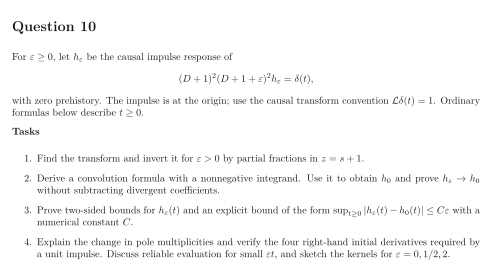
For , let be the causal impulse response of with zero prehistory. The impulse is at the origin; use the causal transform convention . Ordinary formulas below describe .
Tasks
Find the transform and invert it for by partial fractions in .
Derive a convolution formula with a nonnegative integrand. Use it to obtain and prove without subtracting divergent coefficients.
Prove two-sided bounds for and an explicit bound of the form with a numerical constant .
Explain the change in pole multiplicities and verify the four right-hand initial derivatives required by a unit impulse. Discuss reliable evaluation for small , and sketch the kernels for .
Show solutionHide solution
Question 10 – Solution
Strategy. Use partial fractions for a closed form and convolution for a stable coalescing-pole limit.
Step 1: Invert distinct repeated poles. For , and Hence .
Step 2: Take the limit through convolution. Convolving with gives For fixed , dominated convergence justifies the limit, including .
Step 3: Prove global error bounds. Bounding the integrand and using yields The maximum of is at . Thus .
Step 4: Check poles, impulses and evaluation. Two double poles merge into a quadruple pole at ; absolute convergence holds for . Convolution gives , so its right-hand jet is , producing exactly a unit . For small , use the integral or its exponential series; the closed form subtracts large nearly equal terms and can lose significant digits.
See the diagram in the original worksheet below.
