Question 1
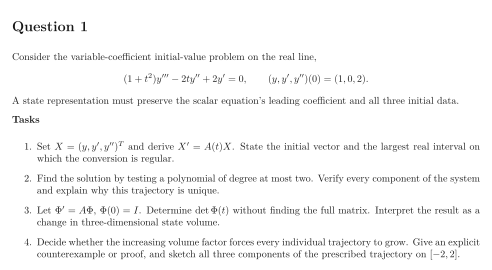
Consider the variable-coefficient initial-value problem on the real line, A state representation must preserve the scalar equation’s leading coefficient and all three initial data.
Tasks
Set and derive . State the initial vector and the largest real interval on which the conversion is regular.
Find the solution by testing a polynomial of degree at most two. Verify every component of the system and explain why this trajectory is unique.
Let , . Determine without finding the full matrix. Interpret the result as a change in three-dimensional state volume.
Decide whether the increasing volume factor forces every individual trajectory to grow. Give an explicit counterexample or proof, and sketch all three components of the prescribed trajectory on .
Show solutionHide solution
Question 1 – Solution
Strategy. Normalize first, and distinguish the evolution of a family of states from that of one trajectory.
Step 1: Preserve the derivative chain. Since for every real , The conversion is regular on , and its first two rows enforce , , so it is reversible.
Step 2: Verify the complete state. The initial data select among quadratic polynomials. Its derivatives are , and the scalar residual is . Thus The system’s last row gives ; the other rows and initial vector also agree. Continuity of gives uniqueness on .
Step 3: Compute the state-volume factor. Liouville’s formula gives An initial parallelepiped of states has its oriented volume multiplied by this positive factor. The factor increases with , not with on the entire line.
Step 4: Test the individual-growth claim. For any constant , is a constant solution. Hence expansion of state volume does not force every trajectory to grow. The prescribed components are shown below; their different behaviors also caution against that inference.
See the diagram in the original worksheet below.
