Question 3
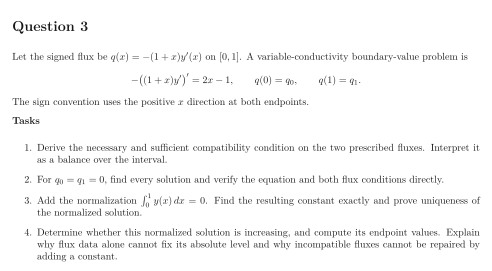
Let the signed flux be on . A variable-conductivity boundary-value problem is The sign convention uses the positive direction at both endpoints.
Tasks
Derive the necessary and sufficient compatibility condition on the two prescribed fluxes. Interpret it as a balance over the interval.
For , find every solution and verify the equation and both flux conditions directly.
Add the normalization . Find the resulting constant exactly and prove uniqueness of the normalized solution.
Determine whether this normalized solution is increasing, and compute its endpoint values. Explain why flux data alone cannot fix its absolute level and why incompatible fluxes cannot be repaired by adding a constant.
Show solutionHide solution
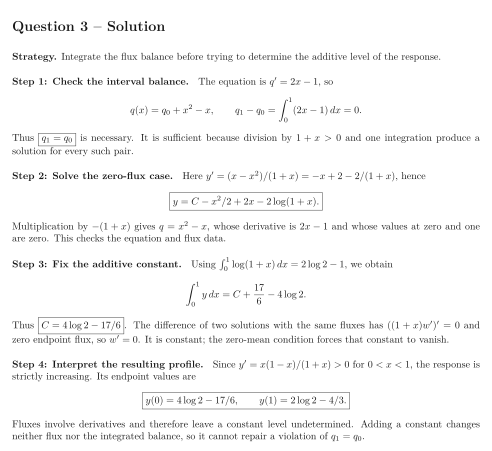
Question 3 – Solution
Strategy. Integrate the flux balance before trying to determine the additive level of the response.
Step 1: Check the interval balance. The equation is , so Thus is necessary. It is sufficient because division by and one integration produce a solution for every such pair.
Step 2: Solve the zero-flux case. Here , hence Multiplication by gives , whose derivative is and whose values at zero and one are zero. This checks the equation and flux data.
Step 3: Fix the additive constant. Using , we obtain Thus . The difference of two solutions with the same fluxes has and zero endpoint flux, so . It is constant; the zero-mean condition forces that constant to vanish.
Step 4: Interpret the resulting profile. Since for , the response is strictly increasing. Its endpoint values are Fluxes involve derivatives and therefore leave a constant level undetermined. Adding a constant changes neither flux nor the integrated balance, so it cannot repair a violation of .