Question 4
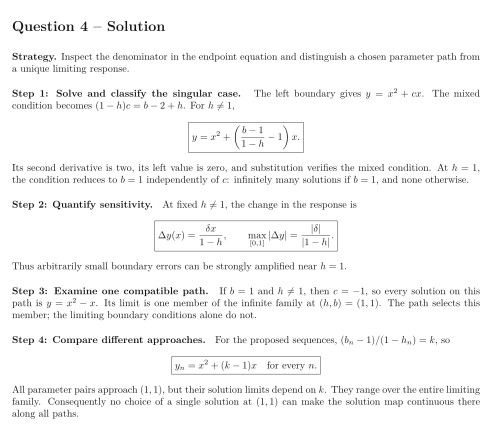
A mixed boundary condition couples endpoint value and slope: where are real parameters.
Tasks
Solve the problem for and verify all data. Classify the number of solutions at for every .
For fixed , determine the exact response to a perturbation . Find its uniform size on .
Follow the path as . Explain how a well-defined limit along this path coexists with nonuniqueness at the limiting parameters.
For arbitrary real , use and to find the limiting solution. Decide whether the boundary-value solution extends continuously as a single-valued function of at .
Show solutionHide solution
Question 4 – Solution
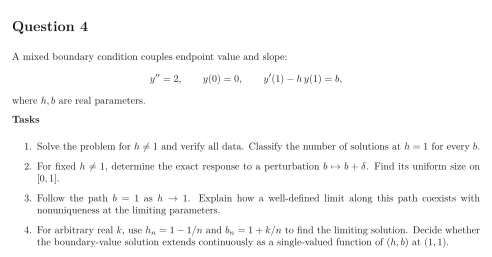
Strategy. Inspect the denominator in the endpoint equation and distinguish a chosen parameter path from a unique limiting response.
Step 1: Solve and classify the singular case. The left boundary gives . The mixed condition becomes . For , Its second derivative is two, its left value is zero, and substitution verifies the mixed condition. At , the condition reduces to independently of : infinitely many solutions if , and none otherwise.
Step 2: Quantify sensitivity. At fixed , the change in the response is Thus arbitrarily small boundary errors can be strongly amplified near .
Step 3: Examine one compatible path. If and , then , so every solution on this path is . Its limit is one member of the infinite family at . The path selects this member; the limiting boundary conditions alone do not.
Step 4: Compare different approaches. For the proposed sequences, , so All parameter pairs approach , but their solution limits depend on . They range over the entire limiting family. Consequently no choice of a single solution at can make the solution map continuous there along all paths.