Question 5
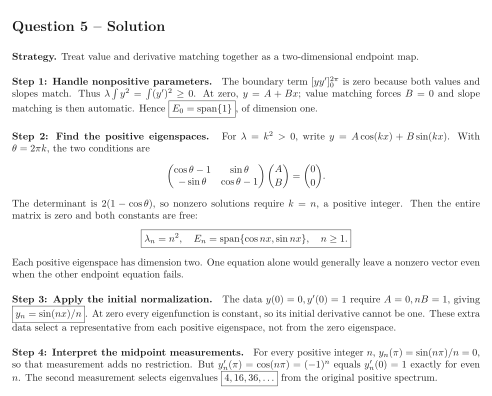
Consider a ring represented by the interval with matching values and slopes at its ends: Here the eigenspace dimension need not be one. No Fourier expansion is required.
Tasks
Rule out negative eigenvalues using the boundary terms in an energy identity, and determine the zero eigenspace directly.
Find all positive eigenvalues and the dimension of each eigenspace. Explain why imposing one endpoint equation alone would be insufficient.
At a positive eigenvalue , impose and . Find the resulting eigenfunction and decide whether these normalization data are possible at zero.
For the normalized positive modes, test the additional measurements and . Which measurement adds no information, and which selects only part of the spectrum?
Show solutionHide solution
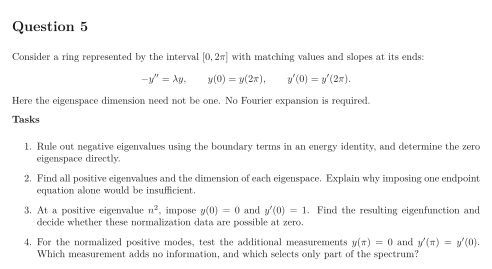
Question 5 – Solution
Strategy. Treat value and derivative matching together as a two-dimensional endpoint map.
Step 1: Handle nonpositive parameters. The boundary term is zero because both values and slopes match. Thus . At zero, ; value matching forces and slope matching is then automatic. Hence , of dimension one.
Step 2: Find the positive eigenspaces. For , write . With , the two conditions are The determinant is , so nonzero solutions require , a positive integer. Then the entire matrix is zero and both constants are free: Each positive eigenspace has dimension two. One equation alone would generally leave a nonzero vector even when the other endpoint equation fails.
Step 3: Apply the initial normalization. The data require , giving . At zero every eigenfunction is constant, so its initial derivative cannot be one. These extra data select a representative from each positive eigenspace, not from the zero eigenspace.
Step 4: Interpret the midpoint measurements. For every positive integer , , so that measurement adds no restriction. But equals exactly for even . The second measurement selects eigenvalues from the original positive spectrum.