Question 6
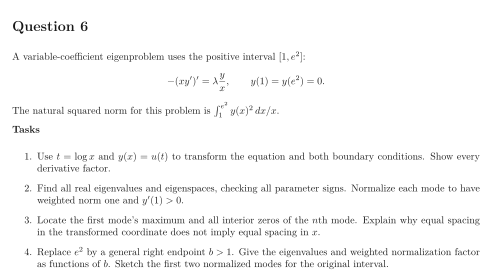
A variable-coefficient eigenproblem uses the positive interval : The natural squared norm for this problem is .
Tasks
Use and to transform the equation and both boundary conditions. Show every derivative factor.
Find all real eigenvalues and eigenspaces, checking all parameter signs. Normalize each mode to have weighted norm one and .
Locate the first mode’s maximum and all interior zeros of the th mode. Explain why equal spacing in the transformed coordinate does not imply equal spacing in .
Replace by a general right endpoint . Give the eigenvalues and weighted normalization factor as functions of . Sketch the first two normalized modes for the original interval.
Show solutionHide solution
Question 6 – Solution
Strategy. Transform the differential equation and its weight together, not just its apparent frequency.
Step 1: Carry out the logarithmic substitution. Since , , and . Multiplying the equation by gives Also , so the weighted squared norm is exactly .
Step 2: Classify and normalize. At zero the affine function with two zero endpoints is zero. At a negative parameter, the left-zero hyperbolic sine cannot vanish at the right endpoint. For , and . Thus The eigenspace is the span of . Its weighted squared norm is one, and , fixing both amplitude and sign.
Step 3: Read locations in the original coordinate. For , the sine attains its unique maximum one when , hence , the geometric rather than arithmetic midpoint of the endpoints. For mode , the interior zeros are . They form a geometric progression: logarithmic spacing becomes multiplicative spacing in .
Step 4: Change the endpoint. For the transformed length is . Consequently The graph for uses the physical coordinate , with the landmark .
See the diagram in the original worksheet below.
