Question 6
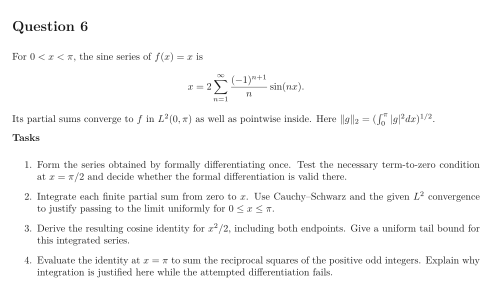
For , the sine series of is Its partial sums converge to in as well as pointwise inside. Here .
Tasks
Form the series obtained by formally differentiating once. Test the necessary term-to-zero condition at and decide whether the formal differentiation is valid there.
Integrate each finite partial sum from zero to . Use Cauchy–Schwarz and the given convergence to justify passing to the limit uniformly for .
Derive the resulting cosine identity for , including both endpoints. Give a uniform tail bound for this integrated series.
Evaluate the identity at to sum the reciprocal squares of the positive odd integers. Explain why integration is justified here while the attempted differentiation fails.
Show solutionHide solution
Question 6 – Solution
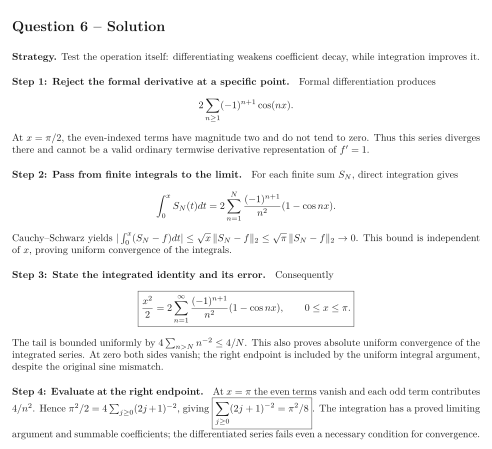
Strategy. Test the operation itself: differentiating weakens coefficient decay, while integration improves it.
Step 1: Reject the formal derivative at a specific point. Formal differentiation produces At , the even-indexed terms have magnitude two and do not tend to zero. Thus this series diverges there and cannot be a valid ordinary termwise derivative representation of .
Step 2: Pass from finite integrals to the limit. For each finite sum , direct integration gives Cauchy–Schwarz yields . This bound is independent of , proving uniform convergence of the integrals.
Step 3: State the integrated identity and its error. Consequently The tail is bounded uniformly by . This also proves absolute uniform convergence of the integrated series. At zero both sides vanish; the right endpoint is included by the uniform integral argument, despite the original sine mismatch.
Step 4: Evaluate at the right endpoint. At the even terms vanish and each odd term contributes . Hence , giving . The integration has a proved limiting argument and summable coefficients; the differentiated series fails even a necessary condition for convergence.