Question 8
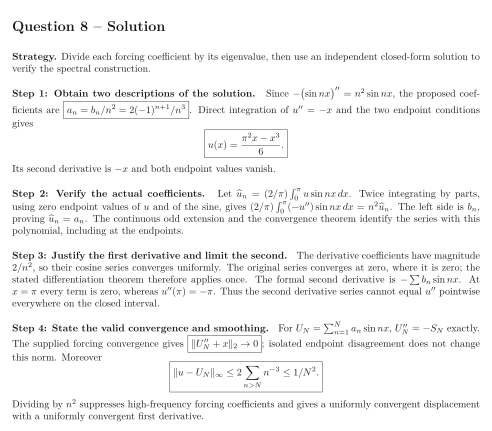
Solve the boundary-value problem using the sine coefficients of the forcing . You may use convergence of its sine series and the standard theorem allowing differentiation when the series of derivatives converges uniformly and the original series converges at one point.
Tasks
Derive the proposed sine coefficients of from the action of on a sine mode. Independently solve the differential equation in closed form.
Verify that the closed-form solution has the proposed sine coefficients using integration by parts and the boundary values.
Justify one termwise differentiation of the solution series. Explain why a second differentiation cannot produce the forcing correctly at the right endpoint as an everywhere pointwise identity.
State precisely how the second derivatives of the finite solution sums converge in . Prove a uniform error bound for the solution itself and explain the smoothing effect of solving the boundary-value problem.
Show solutionHide solution
Question 8 – Solution
Strategy. Divide each forcing coefficient by its eigenvalue, then use an independent closed-form solution to verify the spectral construction.
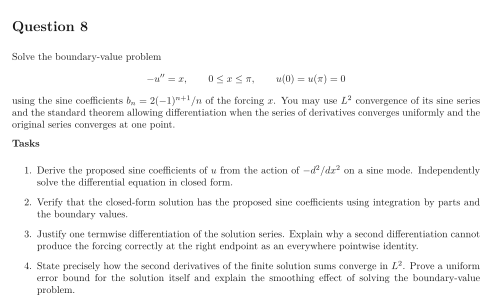
Step 1: Obtain two descriptions of the solution. Since , the proposed coefficients are . Direct integration of and the two endpoint conditions gives Its second derivative is and both endpoint values vanish.
Step 2: Verify the actual coefficients. Let . Twice integrating by parts, using zero endpoint values of and of the sine, gives . The left side is , proving . The continuous odd extension and the convergence theorem identify the series with this polynomial, including at the endpoints.
Step 3: Justify the first derivative and limit the second. The derivative coefficients have magnitude , so their cosine series converges uniformly. The original series converges at zero, where it is zero; the stated differentiation theorem therefore applies once. The formal second derivative is . At every term is zero, whereas . Thus the second derivative series cannot equal pointwise everywhere on the closed interval.
Step 4: State the valid convergence and smoothing. For , exactly. The supplied forcing convergence gives ; isolated endpoint disagreement does not change this norm. Moreover Dividing by suppresses high-frequency forcing coefficients and gives a uniformly convergent displacement with a uniformly convergent first derivative.