Question 9
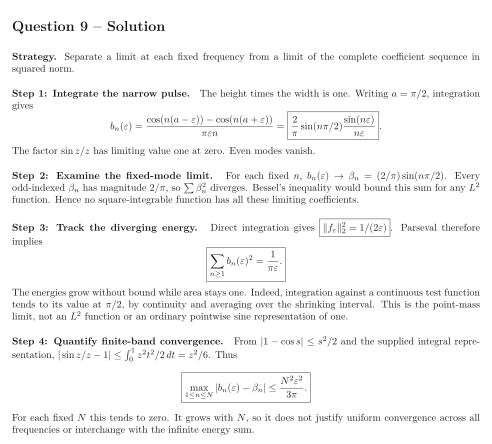
For , define a unit-area narrow pulse centered at : Use . You may use Parseval and Bessel’s inequality for square-integrable functions.
Tasks
Verify the area and derive all sine coefficients. Interpret the value of at by its limit.
Find the limit of each fixed coefficient as . Prove that the limiting coefficient sequence cannot be the sine coefficients of any function.
Compute and use Parseval to find . Explain why a point-mass limit is not an ordinary square-integrable function.
Use to bound the largest coefficient error among . Derive this inequality from and explain why the resulting estimate is not uniform over all mode numbers.
Show solutionHide solution
Question 9 – Solution
Strategy. Separate a limit at each fixed frequency from a limit of the complete coefficient sequence in squared norm.
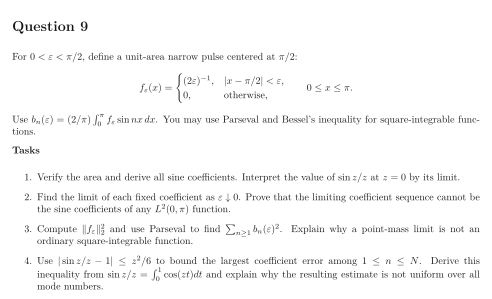
Step 1: Integrate the narrow pulse. The height times the width is one. Writing , integration gives The factor has limiting value one at zero. Even modes vanish.
Step 2: Examine the fixed-mode limit. For each fixed , . Every odd-indexed has magnitude , so diverges. Bessel’s inequality would bound this sum for any function. Hence no square-integrable function has all these limiting coefficients.
Step 3: Track the diverging energy. Direct integration gives . Parseval therefore implies The energies grow without bound while area stays one. Indeed, integration against a continuous test function tends to its value at , by continuity and averaging over the shrinking interval. This is the point-mass limit, not an function or an ordinary pointwise sine representation of one.
Step 4: Quantify finite-band convergence. From and the supplied integral representation, . Thus For each fixed this tends to zero. It grows with , so it does not justify uniform convergence across all frequencies or interchange with the infinite energy sum.