Question 10
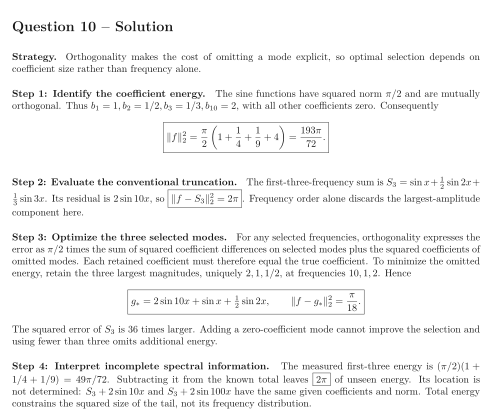
A signal on is An approximation may retain at most three sine modes, with arbitrary real coefficients. Compare this freedom with the usual truncation to the first three frequencies. Use the ordinary squared integral error on .
Tasks
Verify all sine coefficients by orthogonality and compute .
Find the first-three-frequency partial sum and its exact squared error.
Find the best approximation using any three sine modes. Prove both the optimal choice of frequencies and their coefficients, and compare its error with the ordinary low-frequency truncation.
Suppose only the first three coefficients and the total squared norm are known, without the displayed formula for . Determine the unseen energy and explain whether these data locate it at frequency ten. Give two distinct compatible signals.
Show solutionHide solution
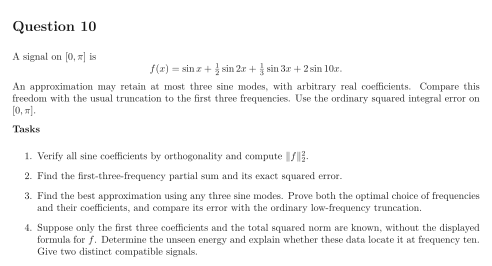
Question 10 – Solution
Strategy. Orthogonality makes the cost of omitting a mode explicit, so optimal selection depends on coefficient size rather than frequency alone.
Step 1: Identify the coefficient energy. The sine functions have squared norm and are mutually orthogonal. Thus , with all other coefficients zero. Consequently
Step 2: Evaluate the conventional truncation. The first-three-frequency sum is . Its residual is , so . Frequency order alone discards the largest-amplitude component here.
Step 3: Optimize the three selected modes. For any selected frequencies, orthogonality expresses the error as times the sum of squared coefficient differences on selected modes plus the squared coefficients of omitted modes. Each retained coefficient must therefore equal the true coefficient. To minimize the omitted energy, retain the three largest magnitudes, uniquely , at frequencies . Hence The squared error of is 36 times larger. Adding a zero-coefficient mode cannot improve the selection and using fewer than three omits additional energy.
Step 4: Interpret incomplete spectral information. The measured first-three energy is . Subtracting it from the known total leaves of unseen energy. Its location is not determined: and have the same given coefficients and norm. Total energy constrains the squared size of the tail, not its frequency distribution.