Question 6
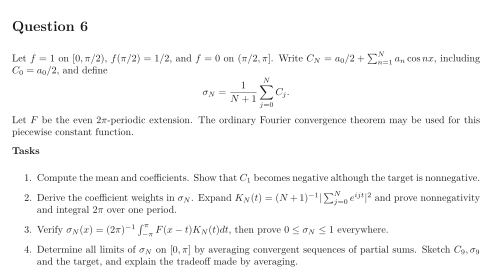
Let on , , and on . Write , including , and define Let be the even -periodic extension. The ordinary Fourier convergence theorem may be used for this piecewise constant function.
Tasks
Compute the mean and coefficients. Show that becomes negative although the target is nonnegative.
Derive the coefficient weights in . Expand and prove nonnegativity and integral over one period.
Verify , then prove everywhere.
Determine all limits of on by averaging convergent sequences of partial sums. Sketch and the target, and explain the tradeoff made by averaging.
Show solutionHide solution
Question 6 – Solution
Strategy. Use an average with a nonnegative kernel and unit total mass to preserve the range of the data.
Step 1: Exhibit a negative partial sum. The mean is and . Thus has minimum at , despite .
Step 2: Compute the weights and kernel. Mode appears in of the partial sums, giving Counting pairs with index difference in the squared modulus gives . The squared-modulus definition proves , and integrating the finite expansion gives .
Step 3: Prove preservation of the range. Insert the finite kernel expansion into the convolution. The average integral of is ; after shifting variables, its sine component vanishes by evenness of . The constant term gives mean . This proves the formula. Because and the kernel is nonnegative with mass ,
Step 4: Identify the limits and tradeoff. Ordinary partial sums tend to one left of the jump, zero right of it, and at the jump. The extension is continuous at zero and , with values one and zero. Arithmetic means of a convergent sequence have the same limit, so has exactly these limits. Averaging damps the higher modes and prevents overshoot, but spreads the finite transition instead of fitting the edge as sharply.
See the diagram in the original worksheet below.
