Question 7
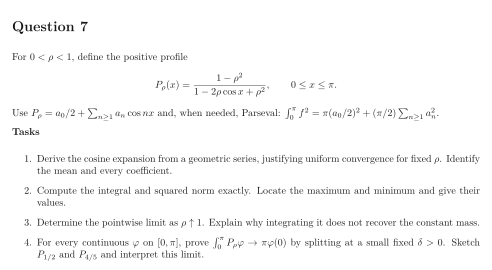
For , define the positive profile Use and, when needed, Parseval: .
Tasks
Derive the cosine expansion from a geometric series, justifying uniform convergence for fixed . Identify the mean and every coefficient.
Compute the integral and squared norm exactly. Locate the maximum and minimum and give their values.
Determine the pointwise limit as . Explain why integrating it does not recover the constant mass.
For every continuous on , prove by splitting at a small fixed . Sketch and and interpret this limit.
Show solutionHide solution
Question 7 – Solution
Strategy. Sum the geometric coefficients exactly, then locate the mass accumulating near the endpoint.
Step 1: Derive the uniformly convergent expansion. The geometric identity gives . Since , its cosine series converges absolutely and uniformly:
Step 2: Compute mass, energy and extrema. Uniform integration gives . Parseval and the geometric sum give The denominator increases with . The maximum at zero is ; the minimum at is .
Step 3: Explain the apparent loss of mass. For fixed , the numerator tends to zero and the denominator to , so . At zero it tends to infinity. The almost-everywhere limit is zero, yet the integral stays . Uniform convergence and interchange of the integral with this limit are not available; the exact squared norm also diverges.
Step 4: Prove endpoint concentration. Given , choose so on . That part of is at most in magnitude. On , uniformly, so the remaining part tends to zero. Letting proves the claim. The limit is mass concentrated at zero, not an ordinary integrable profile.
See the diagram in the original worksheet below.
