Question 9
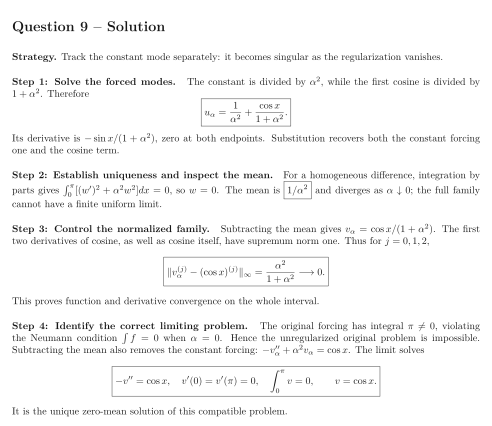
For , consider The zeroth cosine mode has eigenvalue zero for .
Tasks
Solve by cosine modes, treating the constant separately. Verify the equation and both boundary conditions.
Prove uniqueness for by an energy identity. Determine the mean and its behavior as .
Subtract the mean to define . Find its limit and prove uniform convergence of the functions and their first two derivatives.
Explain why the unregularized problem with forcing has no solution, whereas the limit of solves a different normalized problem. State that problem precisely.
Show solutionHide solution
Question 9 – Solution
Strategy. Track the constant mode separately: it becomes singular as the regularization vanishes.
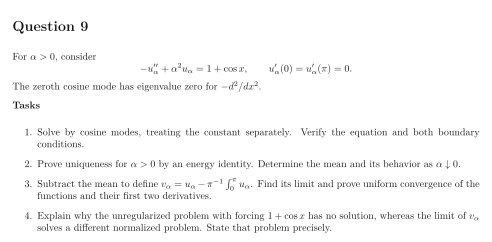
Step 1: Solve the forced modes. The constant is divided by , while the first cosine is divided by . Therefore Its derivative is , zero at both endpoints. Substitution recovers both the constant forcing one and the cosine term.
Step 2: Establish uniqueness and inspect the mean. For a homogeneous difference, integration by parts gives , so . The mean is and diverges as ; the full family cannot have a finite uniform limit.
Step 3: Control the normalized family. Subtracting the mean gives . The first two derivatives of cosine, as well as cosine itself, have supremum norm one. Thus for , This proves function and derivative convergence on the whole interval.
Step 4: Identify the correct limiting problem. The original forcing has integral , violating the Neumann condition when . Hence the unregularized original problem is impossible. Subtracting the mean also removes the constant forcing: . The limit solves It is the unique zero-mean solution of this compatible problem.