Question 10
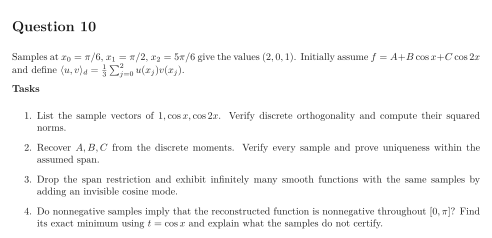
Samples at , , give the values . Initially assume and define .
Tasks
List the sample vectors of . Verify discrete orthogonality and compute their squared norms.
Recover from the discrete moments. Verify every sample and prove uniqueness within the assumed span.
Drop the span restriction and exhibit infinitely many smooth functions with the same samples by adding an invisible cosine mode.
Do nonnegative samples imply that the reconstructed function is nonnegative throughout ? Find its exact minimum using and explain what the samples do not certify.
Show solutionHide solution
Question 10 – Solution
Strategy. Distinguish reconstruction in a finite discrete basis from claims about unmeasured modes or intermediate values.
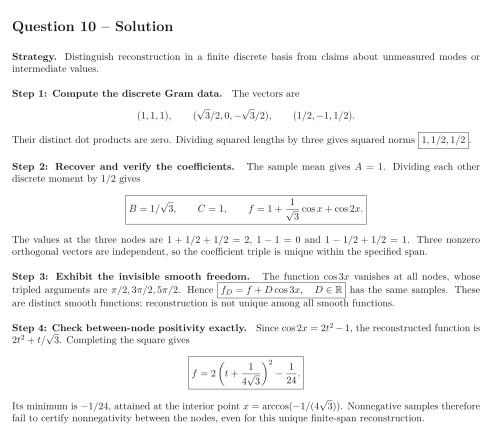
Step 1: Compute the discrete Gram data. The vectors are Their distinct dot products are zero. Dividing squared lengths by three gives squared norms .
Step 2: Recover and verify the coefficients. The sample mean gives . Dividing each other discrete moment by gives The values at the three nodes are , and . Three nonzero orthogonal vectors are independent, so the coefficient triple is unique within the specified span.
Step 3: Exhibit the invisible smooth freedom. The function vanishes at all nodes, whose tripled arguments are . Hence has the same samples. These are distinct smooth functions; reconstruction is not unique among all smooth functions.
Step 4: Check between-node positivity exactly. Since , the reconstructed function is . Completing the square gives Its minimum is , attained at the interior point . Nonnegative samples therefore fail to certify nonnegativity between the nodes, even for this unique finite-span reconstruction.