Question 3
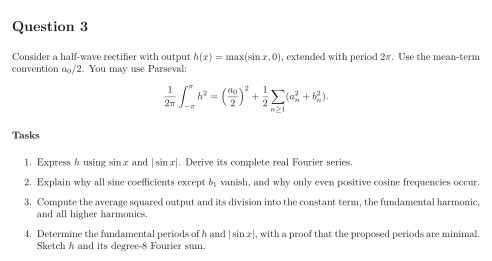
Consider a half-wave rectifier with output , extended with period . Use the mean-term convention . You may use Parseval:
Tasks
Express using and . Derive its complete real Fourier series.
Explain why all sine coefficients except vanish, and why only even positive cosine frequencies occur.
Compute the average squared output and its division into the constant term, the fundamental harmonic, and all higher harmonics.
Determine the fundamental periods of and , with a proof that the proposed periods are minimal. Sketch and its degree-8 Fourier sum.
Show solutionHide solution
Question 3 – Solution
Strategy. Rectification combines an odd fundamental with an even function of half the period.
Step 1: Derive the expansion. Since , its mean is . Direct integration on gives and for . For , product-to-sum integration gives Odd cosine coefficients vanish, including . Thus The coefficients are absolutely summable; the standard piecewise smooth Fourier theorem identifies the sum with this continuous target, including its corners.
Step 2: Explain the selection rules. The function is even, so contributes only cosines. It is also -periodic, eliminating odd cosine frequencies in a expansion. The remaining odd part is exactly , so it contributes only . The full rectified waveform is neither even nor odd.
Step 3: Account for the average power. Direct integration gives . Orthogonality separates the nonnegative contributions: They sum to . The higher-harmonic contribution is positive; the mean squared is only the constant contribution, not the total average squared output.
Step 4: Prove the fundamental periods. The maxima of occur exactly at . Any positive period must take one maximum to another, hence be a positive multiple of ; works. The maxima of occur at , so its least positive period is . Thus the full output has fundamental period despite its even-frequency cosine terms: its nonzero sine fundamental matters.
See the diagram in the original worksheet below.
