Question 4
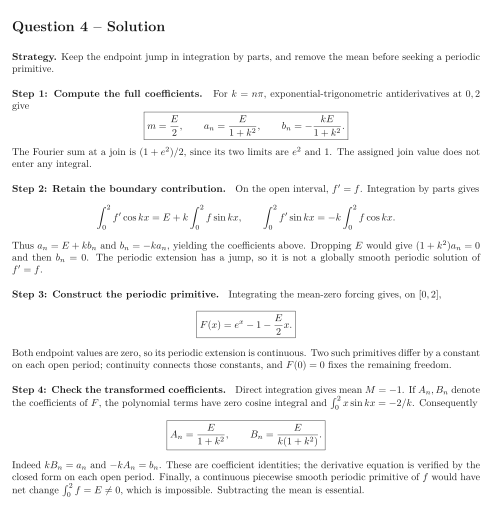
Let for and extend periodically with period . At each join assign the average . Write Set .
Tasks
Derive . Identify the series sum at the periodic join.
Use integration by parts on inside to obtain two coefficient relations. Explain why omitting the boundary jump would incorrectly force every positive-frequency coefficient to zero.
Find a continuous -periodic function with away from the joins and . Prove uniqueness under this normalization.
Compute the mean and all Fourier coefficients of directly. Verify that differentiating its positive-frequency terms formally gives those of , and explain why itself cannot have a continuous periodic primitive.
Show solutionHide solution
Question 4 – Solution
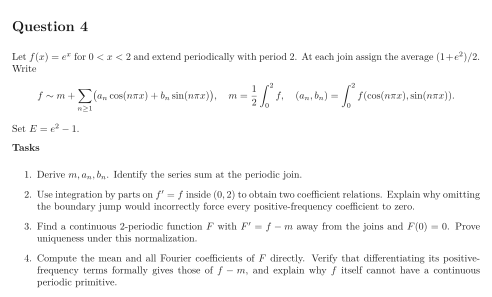
Strategy. Keep the endpoint jump in integration by parts, and remove the mean before seeking a periodic primitive.
Step 1: Compute the full coefficients. For , exponential-trigonometric antiderivatives at give The Fourier sum at a join is , since its two limits are and . The assigned join value does not enter any integral.
Step 2: Retain the boundary contribution. On the open interval, . Integration by parts gives Thus and , yielding the coefficients above. Dropping would give and then . The periodic extension has a jump, so it is not a globally smooth periodic solution of .
Step 3: Construct the periodic primitive. Integrating the mean-zero forcing gives, on , Both endpoint values are zero, so its periodic extension is continuous. Two such primitives differ by a constant on each open period; continuity connects those constants, and fixes the remaining freedom.
Step 4: Check the transformed coefficients. Direct integration gives mean . If denote the coefficients of , the polynomial terms have zero cosine integral and . Consequently Indeed and . These are coefficient identities; the derivative equation is verified by the closed form on each open period. Finally, a continuous piecewise smooth periodic primitive of would have net change , which is impossible. Subtracting the mean is essential.