Question 5
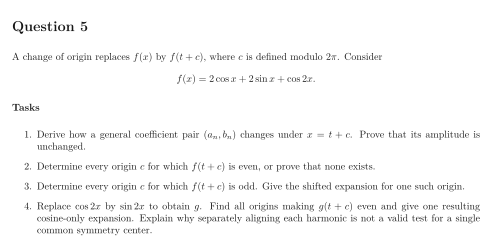
A change of origin replaces by , where is defined modulo . Consider
Tasks
Derive how a general coefficient pair changes under . Prove that its amplitude is unchanged.
Determine every origin for which is even, or prove that none exists.
Determine every origin for which is odd. Give the shifted expansion for one such origin.
Replace by to obtain . Find all origins making even and give one resulting cosine-only expansion. Explain why separately aligning each harmonic is not a valid test for a single common symmetry center.
Show solutionHide solution
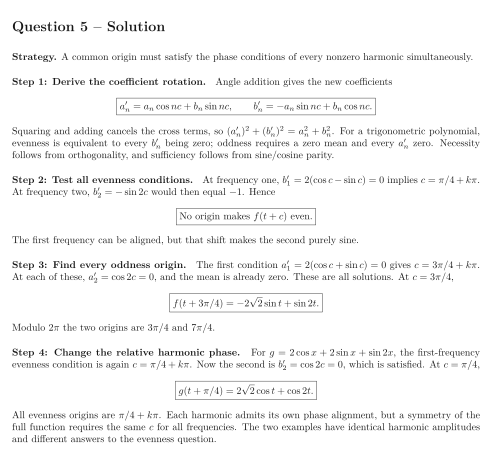
Question 5 – Solution
Strategy. A common origin must satisfy the phase conditions of every nonzero harmonic simultaneously.
Step 1: Derive the coefficient rotation. Angle addition gives the new coefficients Squaring and adding cancels the cross terms, so . For a trigonometric polynomial, evenness is equivalent to every being zero; oddness requires a zero mean and every zero. Necessity follows from orthogonality, and sufficiency follows from sine/cosine parity.
Step 2: Test all evenness conditions. At frequency one, implies . At frequency two, would then equal . Hence The first frequency can be aligned, but that shift makes the second purely sine.
Step 3: Find every oddness origin. The first condition gives . At each of these, , and the mean is already zero. These are all solutions. At , Modulo the two origins are and .
Step 4: Change the relative harmonic phase. For , the first-frequency evenness condition is again . Now the second is , which is satisfied. At , All evenness origins are . Each harmonic admits its own phase alignment, but a symmetry of the full function requires the same for all frequencies. The two examples have identical harmonic amplitudes and different answers to the evenness question.