Question 4
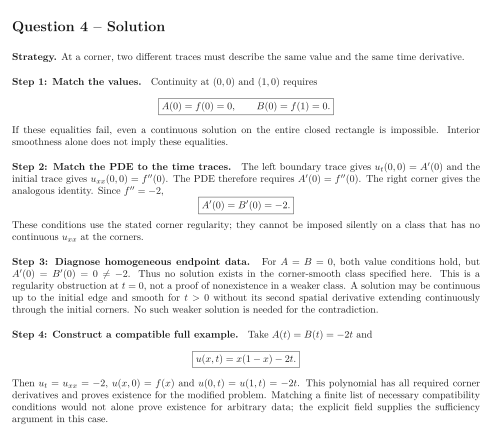
Consider for , , with For this question a solution smooth up to the corners has continuous on the closed rectangle, satisfies the PDE there by continuity, and has and obtained by differentiating its traces. Assume are continuously differentiable.
Tasks
Derive the necessary value compatibility conditions at the two initial corners.
Derive the next necessary compatibility conditions involving and .
Set . Decide whether value compatibility holds and whether a solution in the stated corner-smooth class can exist. Explain why this does not rule out solutions smooth only for positive time.
Keep fixed and construct linear-in-time boundary data for which a polynomial solution exists. Verify the PDE and every datum explicitly; distinguish this sufficiency proof from checking necessary conditions alone.
Show solutionHide solution
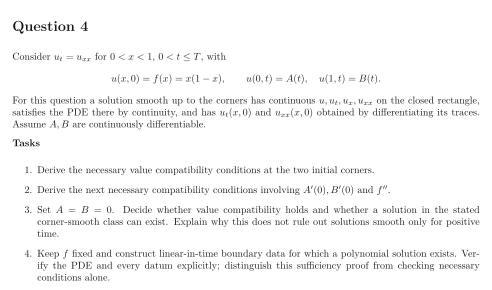
Question 4 – Solution
Strategy. At a corner, two different traces must describe the same value and the same time derivative.
Step 1: Match the values. Continuity at and requires If these equalities fail, even a continuous solution on the entire closed rectangle is impossible. Interior smoothness alone does not imply these equalities.
Step 2: Match the PDE to the time traces. The left boundary trace gives and the initial trace gives . The PDE therefore requires . The right corner gives the analogous identity. Since , These conditions use the stated corner regularity; they cannot be imposed silently on a class that has no continuous at the corners.
Step 3: Diagnose homogeneous endpoint data. For , both value conditions hold, but . Thus no solution exists in the corner-smooth class specified here. This is a regularity obstruction at , not a proof of nonexistence in a weaker class. A solution may be continuous up to the initial edge and smooth for without its second spatial derivative extending continuously through the initial corners. No such weaker solution is needed for the contradiction.
Step 4: Construct a compatible full example. Take and Then , and . This polynomial has all required corner derivatives and proves existence for the modified problem. Matching a finite list of necessary compatibility conditions would not alone prove existence for arbitrary data; the explicit field supplies the sufficiency argument in this case.