Question 6
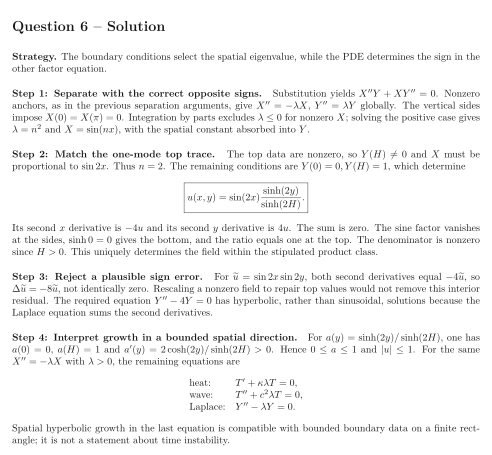
Consider a single product satisfying in the rectangle , , where , with Restrict attention to nonzero smooth separated fields; a general Fourier solution for arbitrary top data is not requested.
Tasks
Derive , and determine the allowable from the two vertical sides.
Use the top data to identify the spatial mode and find . Verify all four boundary conditions and the PDE directly.
Explain why replacing the hyperbolic sine in by an ordinary sine generally fails. Compute the PDE residual for the proposed replacement .
Prove that the solution’s vertical amplitude increases from zero to one, yet its absolute value never exceeds one in the rectangle. Compare the signs of the remaining factor equations for heat, wave and Laplace separation with the same positive .
Show solutionHide solution
Question 6 – Solution
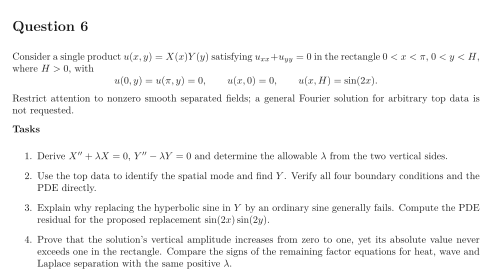
Strategy. The boundary conditions select the spatial eigenvalue, while the PDE determines the sign in the other factor equation.
Step 1: Separate with the correct opposite signs. Substitution yields . Nonzero anchors, as in the previous separation arguments, give , globally. The vertical sides impose . Integration by parts excludes for nonzero ; solving the positive case gives and , with the spatial constant absorbed into .
Step 2: Match the one-mode top trace. The top data are nonzero, so and must be proportional to . Thus . The remaining conditions are , which determine Its second derivative is and its second derivative is . The sum is zero. The sine factor vanishes at the sides, gives the bottom, and the ratio equals one at the top. The denominator is nonzero since . This uniquely determines the field within the stipulated product class.
Step 3: Reject a plausible sign error. For , both second derivatives equal , so , not identically zero. Rescaling a nonzero field to repair top values would not remove this interior residual. The required equation has hyperbolic, rather than sinusoidal, solutions because the Laplace equation sums the second derivatives.
Step 4: Interpret growth in a bounded spatial direction. For , one has , and . Hence and . For the same with , the remaining equations are Spatial hyperbolic growth in the last equation is compatible with bounded boundary data on a finite rectangle; it is not a statement about time instability.