Question 7
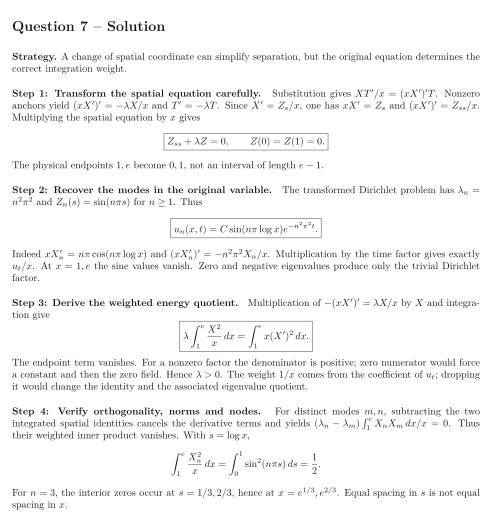
On , , consider the variable-coefficient equation For a nonzero product , use the separation convention , . Introduce and .
Tasks
Derive the factor equations from the PDE and verify, by the chain rule, the transformed spatial equation and its endpoint conditions in .
Determine every eigenvalue and spatial factor and verify the resulting separated fields in the original equation.
Derive an integral identity that proves eigenvalue positivity. Identify the weight in the squared spatial norm; explain why an unweighted denominator would not follow from this equation.
Prove weighted orthogonality of distinct spatial modes by subtracting their ODE identities. Evaluate their squared weighted norms and locate the interior zeros of the third mode in the original coordinate.
Show solutionHide solution
Question 7 – Solution
Strategy. A change of spatial coordinate can simplify separation, but the original equation determines the correct integration weight.
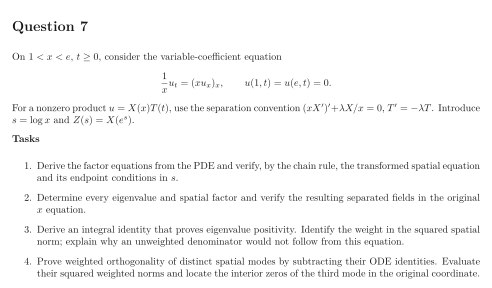
Step 1: Transform the spatial equation carefully. Substitution gives . Nonzero anchors yield and . Since , one has and . Multiplying the spatial equation by gives The physical endpoints become , not an interval of length .
Step 2: Recover the modes in the original variable. The transformed Dirichlet problem has and for . Thus Indeed and . Multiplication by the time factor gives exactly . At the sine values vanish. Zero and negative eigenvalues produce only the trivial Dirichlet factor.
Step 3: Derive the weighted energy quotient. Multiplication of by and integration give The endpoint term vanishes. For a nonzero factor the denominator is positive; zero numerator would force a constant and then the zero field. Hence . The weight comes from the coefficient of ; dropping it would change the identity and the associated eigenvalue quotient.
Step 4: Verify orthogonality, norms and nodes. For distinct modes , subtracting the two integrated spatial identities cancels the derivative terms and yields . Thus their weighted inner product vanishes. With , For , the interior zeros occur at , hence at . Equal spacing in is not equal spacing in .