Question 2
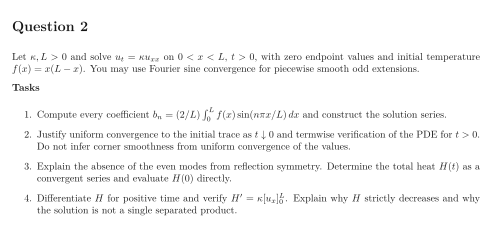
Let and solve on , , with zero endpoint values and initial temperature . You may use Fourier sine convergence for piecewise smooth odd extensions.
Tasks
Compute every coefficient and construct the solution series.
Justify uniform convergence to the initial trace as and termwise verification of the PDE for . Do not infer corner smoothness from uniform convergence of the values.
Explain the absence of the even modes from reflection symmetry. Determine the total heat as a convergent series and evaluate directly.
Differentiate for positive time and verify . Explain why strictly decreases and why the solution is not a single separated product.
Show solutionHide solution
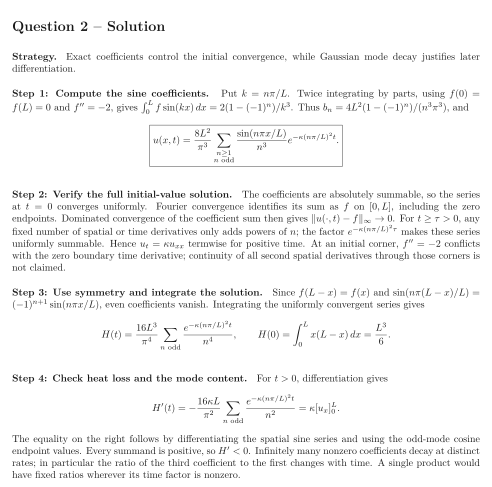
Question 2 – Solution
Strategy. Exact coefficients control the initial convergence, while Gaussian mode decay justifies later differentiation.
Step 1: Compute the sine coefficients. Put . Twice integrating by parts, using and , gives . Thus , and
Step 2: Verify the full initial-value solution. The coefficients are absolutely summable, so the series at converges uniformly. Fourier convergence identifies its sum as on , including the zero endpoints. Dominated convergence of the coefficient sum then gives . For , any fixed number of spatial or time derivatives only adds powers of ; the factor makes these series uniformly summable. Hence termwise for positive time. At an initial corner, conflicts with the zero boundary time derivative; continuity of all second spatial derivatives through those corners is not claimed.
Step 3: Use symmetry and integrate the solution. Since and , even coefficients vanish. Integrating the uniformly convergent series gives
Step 4: Check heat loss and the mode content. For , differentiation gives The equality on the right follows by differentiating the spatial sine series and using the odd-mode cosine endpoint values. Every summand is positive, so . Infinitely many nonzero coefficients decay at distinct rates; in particular the ratio of the third coefficient to the first changes with time. A single product would have fixed ratios wherever its time factor is nonzero.