Question 6
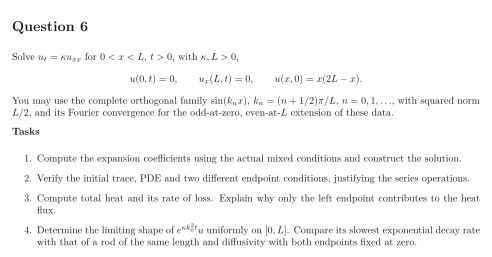
Solve for , , with , You may use the complete orthogonal family , , , with squared norm , and its Fourier convergence for the odd-at-zero, even-at- extension of these data.
Tasks
Compute the expansion coefficients using the actual mixed conditions and construct the solution.
Verify the initial trace, PDE and two different endpoint conditions, justifying the series operations.
Compute total heat and its rate of loss. Explain why only the left endpoint contributes to the heat flux.
Determine the limiting shape of uniformly on . Compare its slowest exponential decay rate with that of a rod of the same length and diffusivity with both endpoints fixed at zero.
Show solutionHide solution
Question 6 – Solution
Strategy. Use half-integer modes for the mixed boundary problem; integer sine modes would solve a different problem.
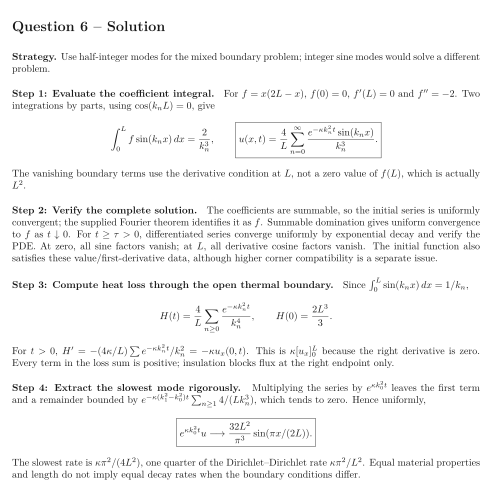
Step 1: Evaluate the coefficient integral. For , , and . Two integrations by parts, using , give The vanishing boundary terms use the derivative condition at , not a zero value of , which is actually .
Step 2: Verify the complete solution. The coefficients are summable, so the initial series is uniformly convergent; the supplied Fourier theorem identifies it as . Summable domination gives uniform convergence to as . For , differentiated series converge uniformly by exponential decay and verify the PDE. At zero, all sine factors vanish; at , all derivative cosine factors vanish. The initial function also satisfies these value/first-derivative data, although higher corner compatibility is a separate issue.
Step 3: Compute heat loss through the open thermal boundary. Since , For , . This is because the right derivative is zero. Every term in the loss sum is positive; insulation blocks flux at the right endpoint only.
Step 4: Extract the slowest mode rigorously. Multiplying the series by leaves the first term and a remainder bounded by , which tends to zero. Hence uniformly, The slowest rate is , one quarter of the Dirichlet–Dirichlet rate . Equal material properties and length do not imply equal decay rates when the boundary conditions differ.