Question 1
Let and . Solve with . Define the rightward diffusive flux as ; the outward flux at the right endpoint is .
Tasks
Determine the unique stationary temperature and explain why it need not have zero flux.
Subtract that stationary field, solve the transformed initial-boundary problem, and verify the reconstructed solution against every original datum.
Take , , , . Determine when the right reservoir receives heat from the rod and when it supplies heat to the rod. Find the exact switching time.
Compute total heat and its flux balance in this example. Sketch profiles at , together with the stationary field, and explain why the hotter endpoint can initially receive heat.
Show solutionHide solution
Question 1 – Solution
Strategy. Separate the maintained stationary gradient from the transient temperature excess.
Step 1: Find the stationary conduction state. Stationarity requires , and the two boundary values give This state is unique because a linear function is determined by two endpoint values. Unless , it carries a constant nonzero flux. Stationary temperature means zero local storage rate, not an absence of heat transport.
Step 2: Solve the homogeneous-boundary transient. With , , and . Thus, writing , Since , differentiation verifies the PDE. The sine vanishes at both ends, and at the original initial field is recovered exactly.
Step 3: Determine the direction of endpoint heat flow. For the given numbers, , so . The right reservoir receives heat when , that is . At the right flux vanishes; for it supplies heat to the rod. The eventual rightward flux is .
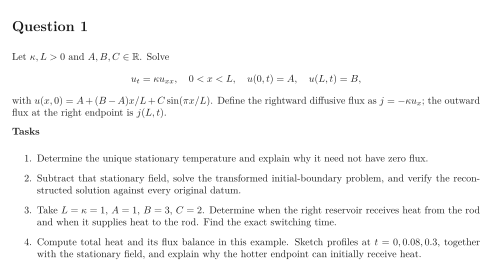
Step 4: Verify the global balance and the profiles. Here , so . Directly and , giving . Initially the interior exceeds the right endpoint temperature, so heat can leave through that endpoint despite its being hotter than the left one.
See the diagram in the original worksheet below.