Question 2
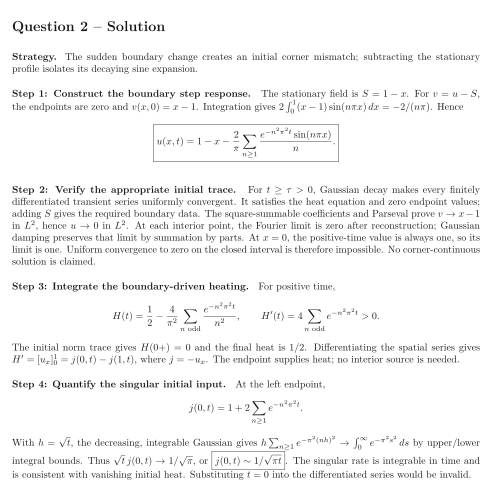
A rod on obeys and is initially at zero temperature in . At the left endpoint is raised to one and held there, while the right remains zero: , for . You may use Fourier sine convergence, Parseval, and .
Tasks
Subtract the stationary field, compute the sine coefficients of the transformed initial data and construct the full solution.
Justify the PDE for positive time and the initial trace. State the initial limit at interior points and at the left endpoint; explain why uniform convergence to the zero initial field is impossible.
Derive a convergent total-heat formula and prove that total heat increases for every positive time, although the source-free PDE has no interior forcing.
Find the rightward flux entering at and its leading behavior as . Use a Riemann-sum limit to justify the singular rate rather than evaluating a divergent series at .
Show solutionHide solution
Question 2 – Solution
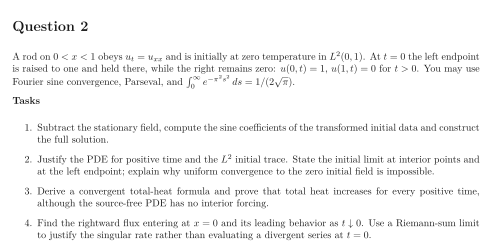
Strategy. The sudden boundary change creates an initial corner mismatch; subtracting the stationary profile isolates its decaying sine expansion.
Step 1: Construct the boundary step response. The stationary field is . For , the endpoints are zero and . Integration gives . Hence
Step 2: Verify the appropriate initial trace. For , Gaussian decay makes every finitely differentiated transient series uniformly convergent. It satisfies the heat equation and zero endpoint values; adding gives the required boundary data. The square-summable coefficients and Parseval prove in , hence in . At each interior point, the Fourier limit is zero after reconstruction; Gaussian damping preserves that limit by summation by parts. At , the positive-time value is always one, so its limit is one. Uniform convergence to zero on the closed interval is therefore impossible. No corner-continuous solution is claimed.
Step 3: Integrate the boundary-driven heating. For positive time, The initial norm trace gives and the final heat is . Differentiating the spatial series gives , where . The endpoint supplies heat; no interior source is needed.
Step 4: Quantify the singular initial input. At the left endpoint, With , the decreasing, integrable Gaussian gives by upper/lower integral bounds. Thus , or . The singular rate is integrable in time and is consistent with vanishing initial heat. Substituting into the differentiated series would be invalid.