Question 3
For , consider uniform internal heating with unequal fixed endpoints: You may use the sine expansion of a smooth zero-endpoint function.
Tasks
Determine the stationary field and find exactly when its maximum lies strictly inside the rod. Locate that maximum.
Subtract the stationary field, compute the transient coefficients and construct the solution satisfying the original linear initial profile.
Verify the reconstructed PDE and data, explain its initial and positive-time regularity, and check the stationary heat-flux balance against the source integral.
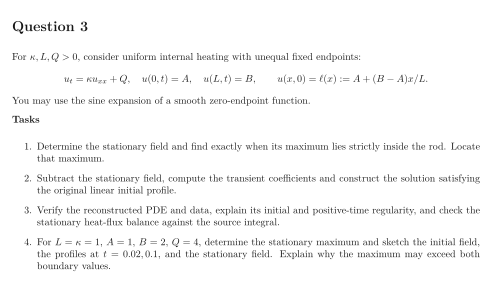
For , , , , determine the stationary maximum and sketch the initial field, the profiles at , and the stationary field. Explain why the maximum may exceed both boundary values.
Show solutionHide solution
Question 3 – Solution
Strategy. Subtract a stationary solution of the forced equation, not just the line joining its boundary values.
Step 1: Solve the stationary forced problem. The equation and the endpoint data give It is strictly concave, with critical point . This is strictly interior exactly when . If equality holds, the maximum is at an endpoint; otherwise the maximum is at the endpoint in the direction of the larger value.
Step 2: Construct the transient from the actual initial difference. For , the PDE and boundaries are homogeneous and . Two integrations by parts give the nonzero coefficients for odd . Therefore
Step 3: Check the PDE, trace and maintained fluxes. The transient solves the homogeneous heat equation; then verifies the forced equation for . The transient vanishes at the ends. Summable coefficients and Fourier convergence recover uniformly. Gaussian decay permits differentiation for . The initial linear profile has , inconsistent with a zero endpoint time derivative at an initial corner, so full corner smoothness is not asserted. For , one has . Hence the steady balance accounts for all generated heat.
Step 4: Interpret the internally heated profile. In the example, , and . The final maximum exceeds both boundary values because heat is generated inside the rod. The source-free maximum principle cannot be applied unchanged to this forced equation. The transient decays uniformly toward the plotted stationary field.
See the diagram in the original worksheet below.