Question 7
On , let and . The right endpoint stays at . The left is held at for and returns to for , where . You may use the unit boundary-step response which has zero initial interior trace, left boundary one and right boundary zero. Set for when discussing the switching time.
Tasks
Construct the solution before and after the switch by superposing boundary step responses. Verify the boundary traces on both open time intervals.
Derive a homogeneous-boundary sine series for , with coefficients at time . Explain continuity at the switch for interior points and why continuity at the switching boundary corner is impossible.
Compute the total excess heat after the switch and prove that it strictly decreases. Determine the long-time equilibrium.
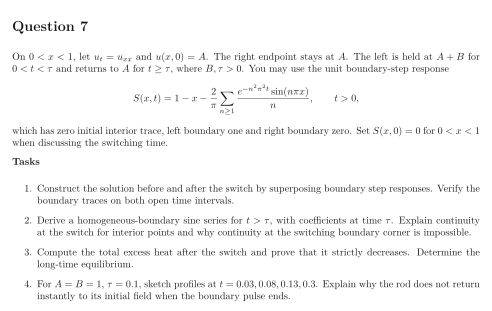
For , , sketch profiles at . Explain why the rod does not return instantly to its initial field when the boundary pulse ends.
Show solutionHide solution
Question 7 – Solution
Strategy. Switching off a boundary step is a delayed negative step; its instantaneous boundary effect does not erase the stored interior heat.
Step 1: Superpose the two boundary events. Linearity gives Each term solves the heat equation in its time interval. Before the switch, the left trace is ; afterward the two unit left traces cancel and leave . Both right traces are always . The initial interior trace is .
Step 2: Identify the post-switch initial data. The stationary lines cancel after the switch, leaving These are the sine coefficients of on the open interval. For every interior , as , so the interior trace agrees with the pre-switch value. The left boundary itself jumps from to ; no single continuous trace at that corner can match both. For times strictly after the switch, all differentiated series converge uniformly by Gaussian decay. The switching trace is also recovered in .
Step 3: Track the retained heat. For , integration yields Its derivative is . This equals after the switch. At any later fixed starting time the exponentially damped coefficients are summable, which proves uniform convergence to the equilibrium as .
Step 4: Interpret the finite pulse. The profiles before the switch have left value two; those after it have left value one. The right value is one throughout. At the switch the excess heat is , as follows from the positive derivative of step-response heat and its zero initial value. It must subsequently diffuse out. A changed boundary value is not an instantaneous reset of the interior.
See the diagram in the original worksheet below.