Question 8
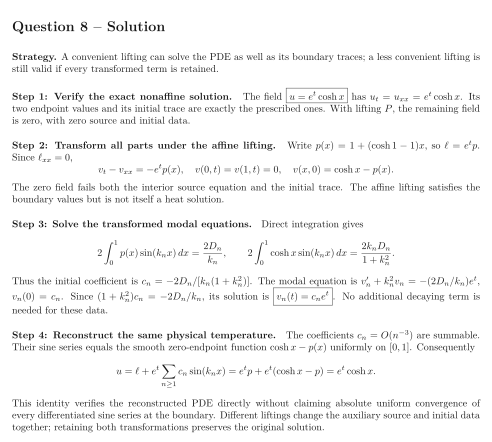
Consider on , with Compare the affine boundary lifting with the nonaffine lifting . You may use the sine expansion of a smooth function vanishing at both endpoints.
Tasks
Verify a closed-form solution of the original problem using , including the PDE and every datum.
For , derive the homogeneous-boundary forced PDE and its initial data. Explain why setting would give the wrong physical field.
Set and . Compute the sine coefficients of the initial difference and the transformed source. Solve the resulting modal initial-value equations.
Reconstruct from the modal solution and prove that it agrees with the closed form. Explain why different liftings can produce different source terms without producing different solutions of the original problem.
Show solutionHide solution
Question 8 – Solution
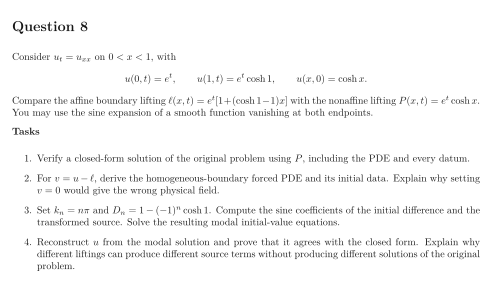
Strategy. A convenient lifting can solve the PDE as well as its boundary traces; a less convenient lifting is still valid if every transformed term is retained.
Step 1: Verify the exact nonaffine solution. The field has . Its two endpoint values and its initial trace are exactly the prescribed ones. With lifting , the remaining field is zero, with zero source and initial data.
Step 2: Transform all parts under the affine lifting. Write , so . Since , The zero field fails both the interior source equation and the initial trace. The affine lifting satisfies the boundary values but is not itself a heat solution.
Step 3: Solve the transformed modal equations. Direct integration gives Thus the initial coefficient is . The modal equation is , . Since , its solution is . No additional decaying term is needed for these data.
Step 4: Reconstruct the same physical temperature. The coefficients are summable. Their sine series equals the smooth zero-endpoint function uniformly on . Consequently This identity verifies the reconstructed PDE directly without claiming absolute uniform convergence of every differentiated sine series at the boundary. Different liftings change the auxiliary source and initial data together; retaining both transformations preserves the original solution.