Question 9
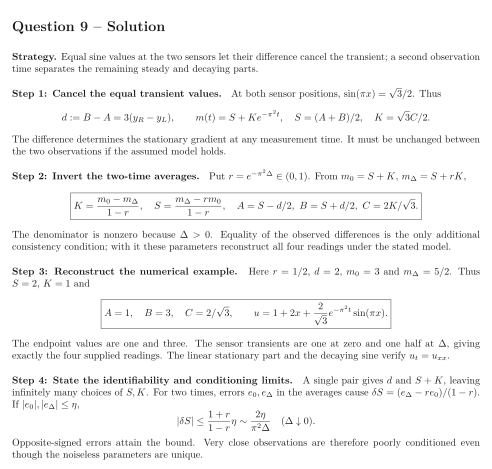
A rod on obeys with unknown constant boundary temperatures . It is known that its full field has the form Sensors at record . Set and let be known.
Tasks
Derive which combination of the readings identifies the stationary gradient immediately, even before the transient has decayed.
Use readings at times to recover uniquely. State the consistency condition on the differences of the two pairs of readings.
For , use readings at zero and at to find the complete field and verify the readings and boundary values.
Explain why one pair of simultaneous readings cannot identify all three parameters. For small , quantify amplification of errors in the two averaged readings when estimating the mean of the boundary temperatures.
Show solutionHide solution
Question 9 – Solution
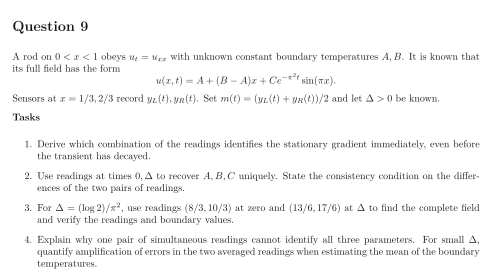
Strategy. Equal sine values at the two sensors let their difference cancel the transient; a second observation time separates the remaining steady and decaying parts.
Step 1: Cancel the equal transient values. At both sensor positions, . Thus The difference determines the stationary gradient at any measurement time. It must be unchanged between the two observations if the assumed model holds.
Step 2: Invert the two-time averages. Put . From , , The denominator is nonzero because . Equality of the observed differences is the only additional consistency condition; with it these parameters reconstruct all four readings under the stated model.
Step 3: Reconstruct the numerical example. Here , , and . Thus , and The endpoint values are one and three. The sensor transients are one at zero and one half at , giving exactly the four supplied readings. The linear stationary part and the decaying sine verify .
Step 4: State the identifiability and conditioning limits. A single pair gives and , leaving infinitely many choices of . For two times, errors in the averages cause . If , Opposite-signed errors attain the bound. Very close observations are therefore poorly conditioned even though the noiseless parameters are unique.