Question 6
A conducting annulus has constant inner and outer temperatures , where and . Conductivity is one. Seek a radial harmonic field. Total outward heat flux means the integral of over the indicated boundary circle.
Tasks
Derive the temperature and prove it is the unique continuous harmonic solution of these boundary data, including among nonradial competitors.
Compute both total boundary fluxes with the annulus’s outward normals. Identify its conductance, defined as the magnitude of transmitted total heat flux divided by .
Compute the Dirichlet energy and describe its relation to the temperature difference and conductance.
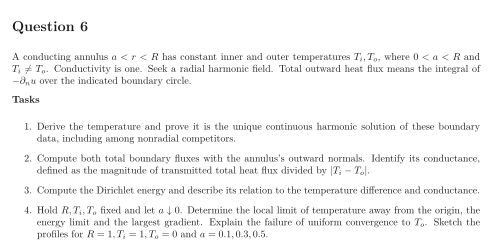
Hold fixed and let . Determine the local limit of temperature away from the origin, the energy limit and the largest gradient. Explain the failure of uniform convergence to . Sketch the profiles for and .
Show solutionHide solution
Question 6 – Solution
Strategy. The logarithmic radial mode is admissible on an annulus, but its small-hole limit is not uniform near the shrinking inner boundary.
Step 1: Solve the radial equation. The equation gives . Writing and , the boundary data give Its radial Laplacian is zero and its two traces are correct. Any other continuous harmonic solution differs by a harmonic function with zero boundary data; the maximum principle on the annulus proves uniqueness.
Step 2: Respect the inner normal. Here . At the outward normal points toward increasing , whereas at it points toward decreasing . Thus The sum is zero. When , heat enters the annulus at the inner boundary and leaves at the outer boundary.
Step 3: Integrate the energy. Direct radial integration yields Equivalently, Green’s identity gives , with the same sign and value.
Step 4: Separate local and uniform limits. As , . On each fixed the field tends uniformly to , and . However for every . Also at the inner circle. The concentration near a shrinking boundary is compatible with vanishing integrated energy.
See the diagram in the original worksheet below.