Question 8
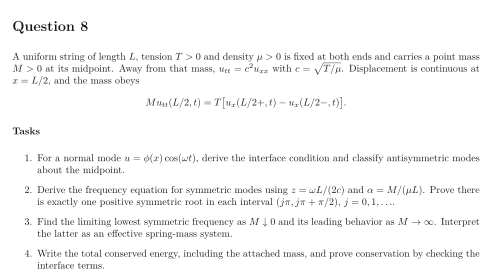
A uniform string of length , tension and density is fixed at both ends and carries a point mass at its midpoint. Away from that mass, with . Displacement is continuous at , and the mass obeys
Tasks
For a normal mode , derive the interface condition and classify antisymmetric modes about the midpoint.
Derive the frequency equation for symmetric modes using and . Prove there is exactly one positive symmetric root in each interval , .
Find the limiting lowest symmetric frequency as and its leading behavior as . Interpret the latter as an effective spring-mass system.
Write the total conserved energy, including the attached mass, and prove conservation by checking the interface terms.
Show solutionHide solution
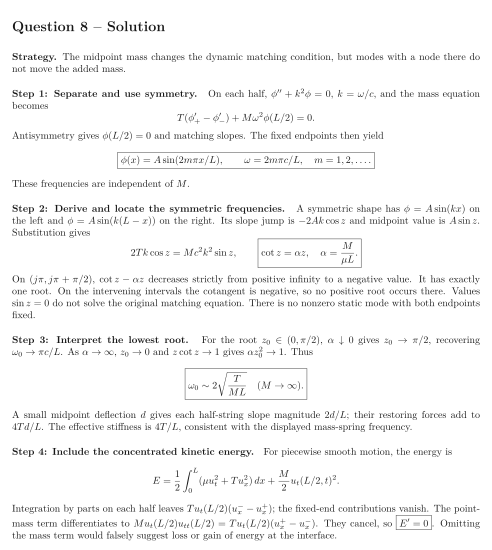
Question 8 – Solution
Strategy. The midpoint mass changes the dynamic matching condition, but modes with a node there do not move the added mass.
Step 1: Separate and use symmetry. On each half, , , and the mass equation becomes Antisymmetry gives and matching slopes. The fixed endpoints then yield These frequencies are independent of .
Step 2: Derive and locate the symmetric frequencies. A symmetric shape has on the left and on the right. Its slope jump is and midpoint value is . Substitution gives On , decreases strictly from positive infinity to a negative value. It has exactly one root. On the intervening intervals the cotangent is negative, so no positive root occurs there. Values do not solve the original matching equation. There is no nonzero static mode with both endpoints fixed.
Step 3: Interpret the lowest root. For the root , gives , recovering . As , and gives . Thus A small midpoint deflection gives each half-string slope magnitude ; their restoring forces add to . The effective stiffness is , consistent with the displayed mass-spring frequency.
Step 4: Include the concentrated kinetic energy. For piecewise smooth motion, the energy is Integration by parts on each half leaves ; the fixed-end contributions vanish. The point-mass term differentiates to . They cancel, so . Omitting the mass term would falsely suggest loss or gain of energy at the interface.