Question 9
A string of length has tension , density and speed . It is initially straight and at rest in the open interval. For , its left end stays fixed while its right end moves upward at constant speed : Only times are considered. Define .
Tasks
Construct the incident wave before it reaches the left end. Locate its front and verify the boundary and initial data in their appropriate senses.
Add the fixed-end reflected wave and obtain one formula valid through . Verify both endpoint displacements and explain the time restriction.
Compute the total string energy on each side of the first reflection time and verify the boundary power balance.
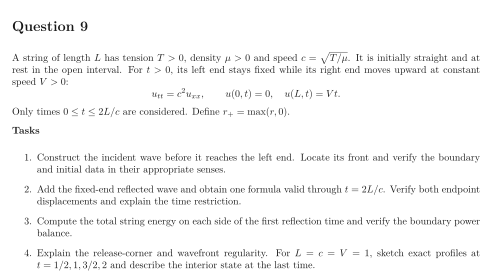
Explain the release-corner and wavefront regularity. For , sketch exact profiles at and describe the interior state at the last time.
Show solutionHide solution
Question 9 – Solution
Strategy. A prescribed end motion launches a ramp front; reflection reverses its displacement sign and transfers the injected energy into a growing slope.
Step 1: Launch the incoming ramp. For , It vanishes ahead of the front and equals at . Every function of satisfies the wave equation distributionally; here it is classical away from the front. At , displacement is zero and velocity is zero at every interior point.
Step 2: Reflect at the fixed left end. The reflected ramp must cancel the incoming displacement at : The left trace is identically zero. At , the second term is zero through , giving . After that time it would change the right trace, so additional reflections would be needed. The formula is not asserted for later times.
Step 3: Balance energy and injected power. Before the first reflection, the moving portion has length , with and . Since , its energy is . For , the reflected left portion has length , velocity zero and slope ; the right portion has length , velocity and slope . Hence again For , the right-end slope is , so the input power is .
Step 4: Interpret the corner and the final snapshot. The initial interior velocity is zero, but the driven endpoint velocity jumps to : no continuous velocity at that release corner is possible. Displacement stays continuous across each front, while first derivatives jump; the weak wave equation remains valid. At , and the open-interval velocity is zero; energy is entirely elastic, . The endpoint still moves, so this is not a smooth state of rest that persists afterward.
See the diagram in the original worksheet below.