Question 10
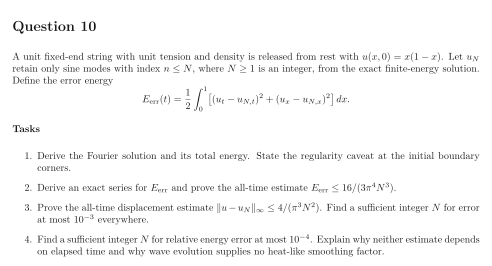
A unit fixed-end string with unit tension and density is released from rest with . Let retain only sine modes with index , where is an integer, from the exact finite-energy solution. Define the error energy
Tasks
Derive the Fourier solution and its total energy. State the regularity caveat at the initial boundary corners.
Derive an exact series for and prove the all-time estimate .
Prove the all-time displacement estimate . Find a sufficient integer for error at most everywhere.
Find a sufficient integer for relative energy error at most . Explain why neither estimate depends on elapsed time and why wave evolution supplies no heat-like smoothing factor.
Show solutionHide solution
Question 10 – Solution
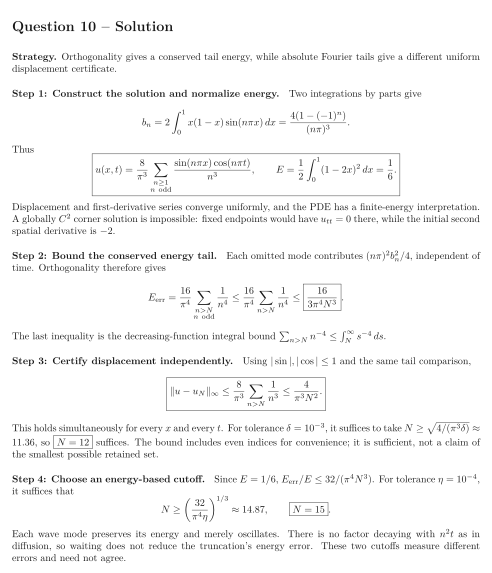
Strategy. Orthogonality gives a conserved tail energy, while absolute Fourier tails give a different uniform displacement certificate.
Step 1: Construct the solution and normalize energy. Two integrations by parts give Thus Displacement and first-derivative series converge uniformly, and the PDE has a finite-energy interpretation. A globally corner solution is impossible: fixed endpoints would have there, while the initial second spatial derivative is .
Step 2: Bound the conserved energy tail. Each omitted mode contributes , independent of time. Orthogonality therefore gives The last inequality is the decreasing-function integral bound .
Step 3: Certify displacement independently. Using and the same tail comparison, This holds simultaneously for every and every . For tolerance , it suffices to take , so suffices. The bound includes even indices for convenience; it is sufficient, not a claim of the smallest possible retained set.
Step 4: Choose an energy-based cutoff. Since , . For tolerance , it suffices that Each wave mode preserves its energy and merely oscillates. There is no factor decaying with as in diffusion, so waiting does not reduce the truncation’s energy error. These two cutoffs measure different errors and need not agree.