Question 1
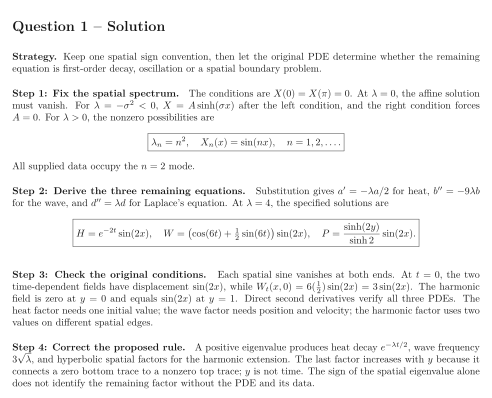
Three problems use the interval with zero values at : The third is on , , with and , as well as the zero side values.
Tasks
Derive the common spatial eigenproblem using . Explain why neither nor gives a nonzero Dirichlet eigenfunction.
Derive the remaining ordinary differential equation for each PDE and solve all three specified problems.
Verify every original datum, including the wave velocity. Explain why the three remaining factors require different kinds or numbers of conditions.
A proposed rule says a positive spatial eigenvalue always produces an exponential decay factor. Diagnose the rule and state the correct behavior for these three problems.
Show solutionHide solution
Question 1 – Solution
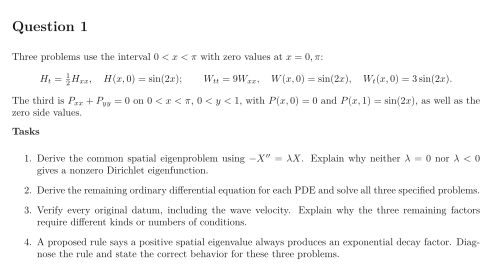
Strategy. Keep one spatial sign convention, then let the original PDE determine whether the remaining equation is first-order decay, oscillation or a spatial boundary problem.
Step 1: Fix the spatial spectrum. The conditions are . At , the affine solution must vanish. For , after the left condition, and the right condition forces . For , the nonzero possibilities are All supplied data occupy the mode.
Step 2: Derive the three remaining equations. Substitution gives for heat, for the wave, and for Laplace’s equation. At , the specified solutions are
Step 3: Check the original conditions. Each spatial sine vanishes at both ends. At , the two time-dependent fields have displacement , while . The harmonic field is zero at and equals at . Direct second derivatives verify all three PDEs. The heat factor needs one initial value; the wave factor needs position and velocity; the harmonic factor uses two values on different spatial edges.
Step 4: Correct the proposed rule. A positive eigenvalue produces heat decay , wave frequency , and hyperbolic spatial factors for the harmonic extension. The last factor increases with because it connects a zero bottom trace to a nonzero top trace; is not time. The sign of the spatial eigenvalue alone does not identify the remaining factor without the PDE and its data.