Question 2
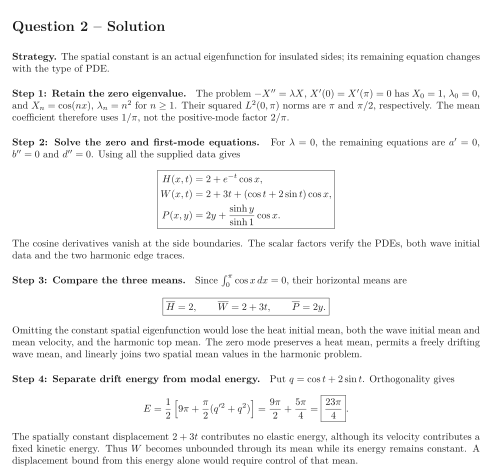
Impose insulated side conditions: at . Consider On , , let be harmonic with and .
Tasks
Derive the Neumann eigenfunctions, including the zero eigenvalue. State the norm of the constant eigenfunction and of each positive cosine mode.
Construct all three solutions, treating their zero modes explicitly.
Compute the horizontal mean in each problem and explain exactly which data would be lost if the zero mode were omitted.
Compute the wave energy . Explain why a constant energy does not imply bounded wave displacement in this setting.
Show solutionHide solution
Question 2 – Solution
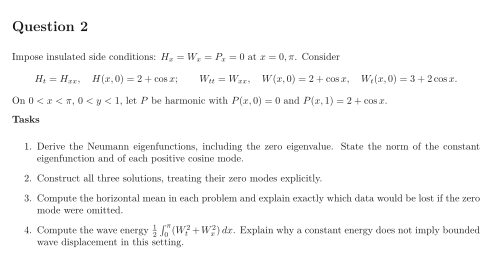
Strategy. The spatial constant is an actual eigenfunction for insulated sides; its remaining equation changes with the type of PDE.
Step 1: Retain the zero eigenvalue. The problem , has , , and , for . Their squared norms are and , respectively. The mean coefficient therefore uses , not the positive-mode factor .
Step 2: Solve the zero and first-mode equations. For , the remaining equations are , and . Using all the supplied data gives The cosine derivatives vanish at the side boundaries. The scalar factors verify the PDEs, both wave initial data and the two harmonic edge traces.
Step 3: Compare the three means. Since , their horizontal means are Omitting the constant spatial eigenfunction would lose the heat initial mean, both the wave initial mean and mean velocity, and the harmonic top mean. The zero mode preserves a heat mean, permits a freely drifting wave mean, and linearly joins two spatial mean values in the harmonic problem.
Step 4: Separate drift energy from modal energy. Put . Orthogonality gives The spatially constant displacement contributes no elastic energy, although its velocity contributes a fixed kinetic energy. Thus becomes unbounded through its mean while its energy remains constant. A displacement bound from this energy alone would require control of that mean.