Question 3
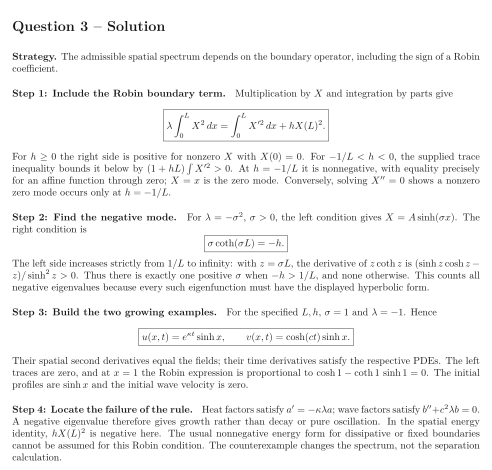
Consider the separated spatial problem where and . The same boundary conditions are imposed on the heat equation and the wave equation , with .
Tasks
Derive the energy identity for . Use to identify when every eigenvalue is positive and when a zero eigenvalue occurs.
For , derive the negative-eigenvalue equation and prove there is exactly one negative eigenvalue.
Choose and . Construct a heat solution and a wave solution with initial profile , taking zero initial wave velocity.
Explain why these solutions invalidate a rule that separated heat modes always decay and separated wave modes always oscillate. Identify the boundary term responsible.
Show solutionHide solution
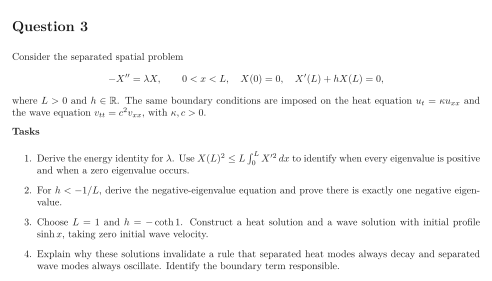
Question 3 – Solution
Strategy. The admissible spatial spectrum depends on the boundary operator, including the sign of a Robin coefficient.
Step 1: Include the Robin boundary term. Multiplication by and integration by parts give For the right side is positive for nonzero with . For , the supplied trace inequality bounds it below by . At it is nonnegative, with equality precisely for an affine function through zero; is the zero mode. Conversely, solving shows a nonzero zero mode occurs only at .
Step 2: Find the negative mode. For , , the left condition gives . The right condition is The left side increases strictly from to infinity: with , the derivative of is . Thus there is exactly one positive when , and none otherwise. This counts all negative eigenvalues because every such eigenfunction must have the displayed hyperbolic form.
Step 3: Build the two growing examples. For the specified , and . Hence Their spatial second derivatives equal the fields; their time derivatives satisfy the respective PDEs. The left traces are zero, and at the Robin expression is proportional to . The initial profiles are and the initial wave velocity is zero.
Step 4: Locate the failure of the rule. Heat factors satisfy ; wave factors satisfy . A negative eigenvalue therefore gives growth rather than decay or pure oscillation. In the spatial energy identity, is negative here. The usual nonnegative energy form for dissipative or fixed boundaries cannot be assumed for this Robin condition. The counterexample changes the spectrum, not the separation calculation.