Question 8
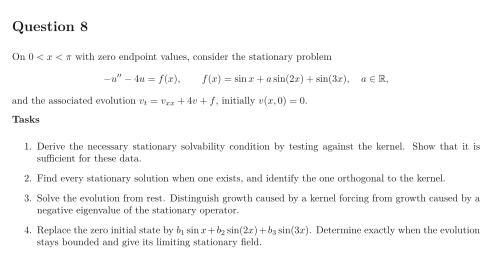
On with zero endpoint values, consider the stationary problem and the associated evolution , initially .
Tasks
Derive the necessary stationary solvability condition by testing against the kernel. Show that it is sufficient for these data.
Find every stationary solution when one exists, and identify the one orthogonal to the kernel.
Solve the evolution from rest. Distinguish growth caused by a kernel forcing from growth caused by a negative eigenvalue of the stationary operator.
Replace the zero initial state by . Determine exactly when the evolution stays bounded and give its limiting stationary field.
Show solutionHide solution
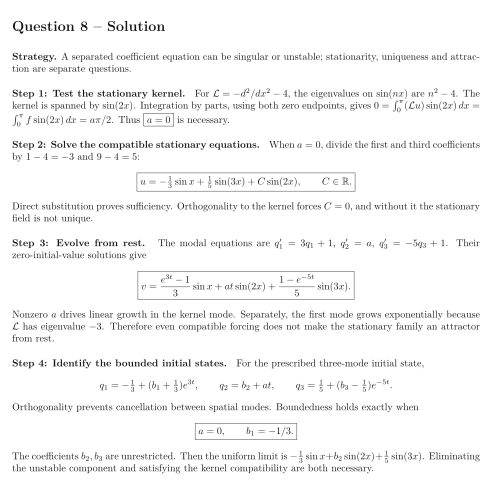
Question 8 – Solution
Strategy. A separated coefficient equation can be singular or unstable; stationarity, uniqueness and attraction are separate questions.
Step 1: Test the stationary kernel. For , the eigenvalues on are . The kernel is spanned by . Integration by parts, using both zero endpoints, gives . Thus is necessary.
Step 2: Solve the compatible stationary equations. When , divide the first and third coefficients by and : Direct substitution proves sufficiency. Orthogonality to the kernel forces , and without it the stationary field is not unique.
Step 3: Evolve from rest. The modal equations are , , . Their zero-initial-value solutions give Nonzero drives linear growth in the kernel mode. Separately, the first mode grows exponentially because has eigenvalue . Therefore even compatible forcing does not make the stationary family an attractor from rest.
Step 4: Identify the bounded initial states. For the prescribed three-mode initial state, Orthogonality prevents cancellation between spatial modes. Boundedness holds exactly when The coefficients are unrestricted. Then the uniform limit is . Eliminating the unstable component and satisfying the kernel compatibility are both necessary.