Question 9
Let on , with zero endpoint values and . A proposed solution strategy assumes that the complete answer is one product because the PDE is separable.
Tasks
Derive the exact solution and explain why separability of the PDE does not force every solution to be a single product.
Prove that a nonzero product solution must use a spatial eigenfunction. Explain how the argument handles zeros of or .
Test the exact solution with the two-by-two sample determinant at , , , . Compute it and use it to rule out one-product factorization.
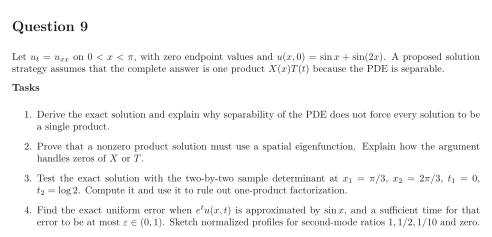
Find the exact uniform error when is approximated by , and a sufficient time for that error to be at most . Sketch normalized profiles for second-mode ratios and zero.
Show solutionHide solution
Question 9 – Solution
Strategy. An eigenfunction expansion can become nearly one mode without ever being exactly one product at a finite time.
Step 1: Superpose the two decays. The eigenvalues are one and four, so The PDE and every datum follow term by term. Separation constructs building blocks; linearity allows their sums, whose distinct temporal factors need not combine into one product.
Step 2: Derive the restriction on a product. If is a nonzero classical product, then . Choose a time with and points where . The ratios satisfy , independent of both variables. The differential identity extends across spatial zeros by continuity; the temporal ODE extends likewise. Zero boundary values give the Dirichlet eigenproblem. The trivial zero product is separate. Division at zeros is unnecessary and cannot create extra eigenfunctions.
Step 3: Use a factorization invariant. Every product has determinant For the stated points, the four entries are Their determinant is , proving that the exact field is not one product.
Step 4: Quantify approximate separation. The normalized field is , so Equality in the norm follows at a point where . The plotted ratios correspond to and the limiting profile. Approximation by a surviving mode does not retroactively justify a single-product initial ansatz.
See the diagram in the original worksheet below.