Estimating the Value of a Series — Question 9
Question 9
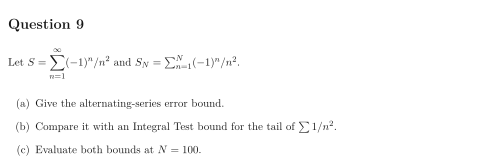
Let
and
.
Give the alternating-series error bound.
Compare it with an Integral Test bound for the tail of
.
Evaluate both bounds at
.
Show solutionHide solution+
Question 9 –
Solution
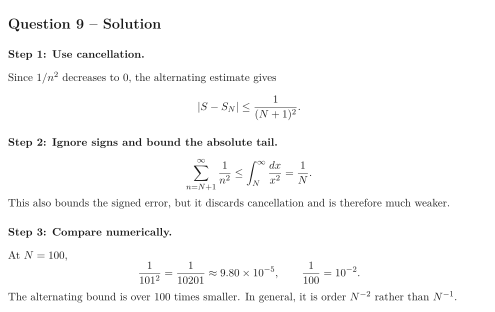
Step 1: Use cancellation.
Since
decreases to
,
the alternating estimate gives
Step 2: Ignore
signs and bound the absolute tail.
This also bounds the signed error, but it discards cancellation and is
therefore much weaker.
Step 3: Compare numerically.
At
,
The alternating bound is over
times smaller. In general, it is order
rather than
.
Original worksheet layout. Use Enlarge or open the PDF for a closer view.