Taylor Series — Question 9

PDF ↗

Question 9

Use the generalized binomial coefficients to find the first four nonzero terms of the Maclaurin series for 1+x\sqrt{1+x}. State the radius and determine convergence at both endpoints.

Original worksheet page 1: question and worked solution for 4-16-009
Show solutionHide solution

Question 9 – Solution

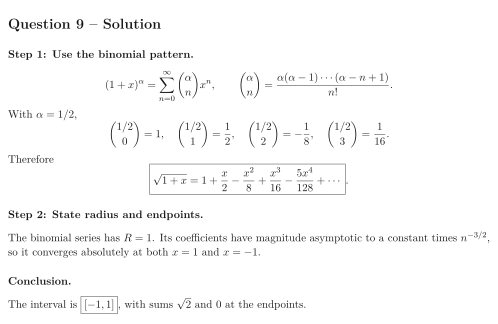
Step 1: Use the binomial pattern.

(1+x)α=∑n=0∞(αn)xn,(αn)=α(α−1)⋯(α−n+1)n!.(1+x)^{\alpha}=\sum_{n=0}^{\infty}\binom{\alpha}{n}x^n,\qquad \binom{\alpha}{n}=\frac{\alpha(\alpha-1)\cdots(\alpha-n+1)}{n!}. With α=1/2\alpha=1/2, (1/20)=1,(1/21)=12,(1/22)=−18,(1/23)=116.\binom{1/2}{0}=1,\quad\binom{1/2}{1}=\frac12,\quad\binom{1/2}{2}=-\frac18,\quad\binom{1/2}{3}=\frac1{16}. Therefore 1+x=1+x2−x28+x316−5x4128+⋯.\boxed{\sqrt{1+x}=1+\frac{x}{2}-\frac{x^2}{8}+\frac{x^3}{16}-\frac{5x^4}{128}+\cdots}.

Step 2: State radius and endpoints.

The binomial series has R=1R=1. Its coefficients have magnitude asymptotic to a constant times n−3/2n^{-3/2}, so it converges absolutely at both x=1x=1 and x=−1x=-1.

Conclusion.

The interval is [−1,1]\boxed{[-1,1]}, with sums 2\sqrt2 and 00 at the endpoints.

Original worksheet page 2: question and worked solution for 4-16-009

Original worksheet layout. Use Enlarge or open the PDF for a closer view.