Partial Derivatives — Question 8

PDF ↗

Question 8

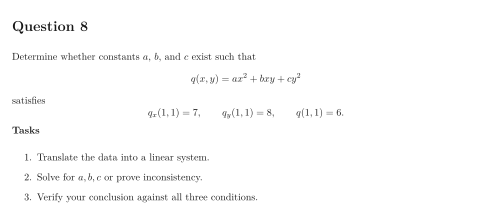
Determine whether constants aa, bb, and cc exist such that q(x,y)=ax2+bxy+cy2q(x,y)=ax^2+bxy+cy^2 satisfies qx(1,1)=7,qy(1,1)=8,q(1,1)=6.q_x(1,1)=7,\qquad q_y(1,1)=8,\qquad q(1,1)=6. Tasks

  1. Translate the data into a linear system.

  2. Solve for a,b,ca,b,c or prove inconsistency.

  3. Verify your conclusion against all three conditions.
Original worksheet page 1: question and worked solution for 2-2-008
Show solutionHide solution

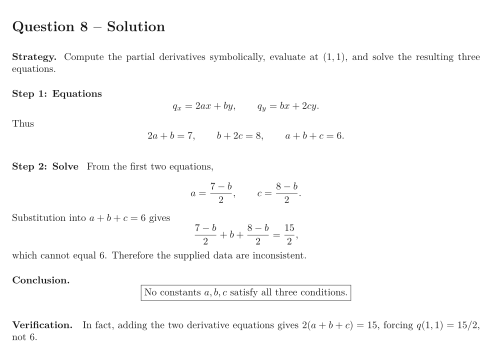
Question 8 – Solution

Strategy. Compute the partial derivatives symbolically, evaluate at (1,1)(1,1), and solve the resulting three equations.

Step 1: Equations qx=2ax+by,qy=bx+2cy.q_x=2ax+by,\qquad q_y=bx+2cy. Thus 2a+b=7,b+2c=8,a+b+c=6.2a+b=7,\qquad b+2c=8,\qquad a+b+c=6.

Step 2: Solve From the first two equations, a=7−b2,c=8−b2.a=\frac{7-b}{2},\qquad c=\frac{8-b}{2}. Substitution into a+b+c=6a+b+c=6 gives 7−b2+b+8−b2=152,\frac{7-b}{2}+b+\frac{8-b}{2}=\frac{15}{2}, which cannot equal 66. Therefore the supplied data are inconsistent.

Conclusion. No constants a,b,c satisfy all three conditions.\boxed{\text{No constants }a,b,c\text{ satisfy all three conditions.}}

Verification. In fact, adding the two derivative equations gives 2(a+b+c)=152(a+b+c)=15, forcing q(1,1)=15/2q(1,1)=15/2, not 66.

Original worksheet page 2: question and worked solution for 2-2-008

Original worksheet layout. Use Enlarge or open the PDF for a closer view.