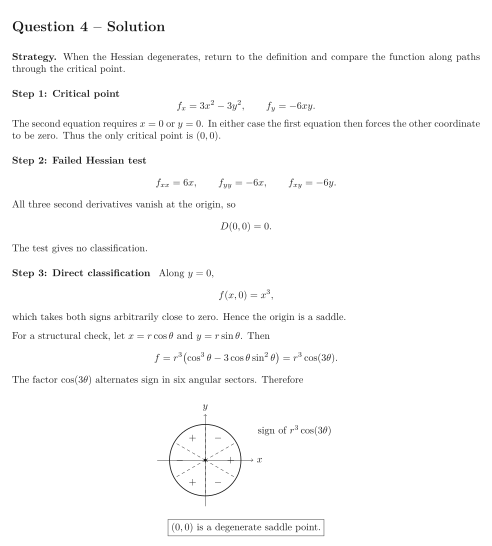
Question 4
Consider the “monkey saddle”
Tasks
Find all critical points.
Show precisely why the second derivative test is inconclusive there.
Classify the point using both simple paths and the polar form of the function.
Show solutionHide solution
Question 4 – Solution
Strategy. When the Hessian degenerates, return to the definition and compare the function along paths through the critical point.
Step 1: Critical point The second equation requires or . In either case the first equation then forces the other coordinate to be zero. Thus the only critical point is .
Step 2: Failed Hessian test All three second derivatives vanish at the origin, so The test gives no classification.
Step 3: Direct classification Along , which takes both signs arbitrarily close to zero. Hence the origin is a saddle.
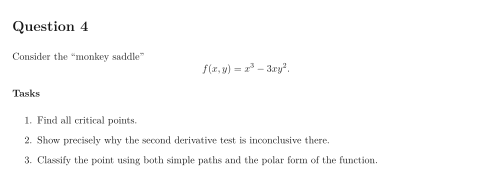
For a structural check, let and . Then The factor alternates sign in six angular sectors. Therefore
See the diagram in the original worksheet below.