Curl and Divergence — Question 8

PDF ↗

Question 8

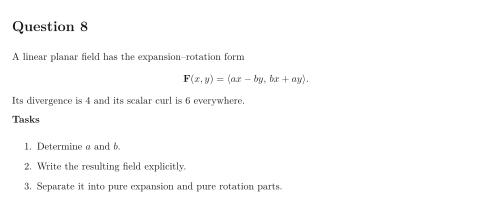
A linear planar field has the expansion–rotation form 𝑭(x,y)=⟨ax−by,bx+ay⟩.\mathbf F(x,y)=\langle ax-by,\,bx+ay\rangle. Its divergence is 44 and its scalar curl is 66 everywhere.

Tasks

  1. Determine aa and bb.

  2. Write the resulting field explicitly.

  3. Separate it into pure expansion and pure rotation parts.
Original worksheet page 1: question and worked solution for 6-1-008
Show solutionHide solution

Question 8 – Solution

Strategy. Divergence isolates the expansion coefficient, while scalar curl isolates twice the rotation coefficient.

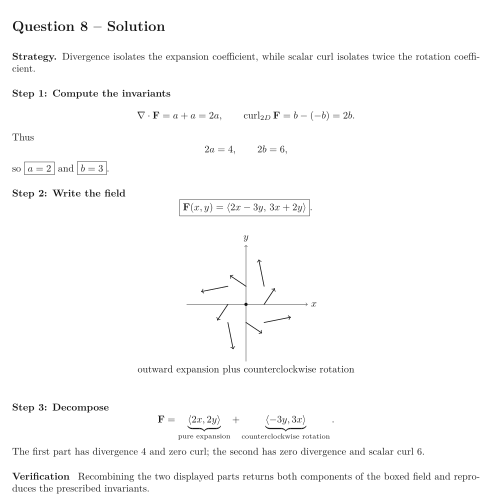
Step 1: Compute the invariants ∇⋅𝑭=a+a=2a,curl⁡2D𝑭=b−(−b)=2b.\nabla\cdot\mathbf F=a+a=2a, \qquad \operatorname{curl}_{2D}\mathbf F=b-(-b)=2b. Thus 2a=4,2b=6,2a=4, \qquad 2b=6, so a=2\boxed{a=2} and b=3\boxed{b=3}.

Step 2: Write the field 𝑭(x,y)=⟨2x−3y,3x+2y⟩.\boxed{\mathbf F(x,y)=\langle 2x-3y,\,3x+2y\rangle}.

See the diagram in the original worksheet below.

Step 3: Decompose 𝑭=⟨2x,2y⟩⏟pure expansion+⟨−3y,3x⟩⏟counterclockwise rotation.\mathbf F =\underbrace{\langle 2x,2y\rangle}_{\text{pure expansion}} +\underbrace{\langle-3y,3x\rangle}_{\text{counterclockwise rotation}}. The first part has divergence 44 and zero curl; the second has zero divergence and scalar curl 66.

Verification Recombining the two displayed parts returns both components of the boxed field and reproduces the prescribed invariants.
Original worksheet page 2: question and worked solution for 6-1-008

Original worksheet layout. Use Enlarge or open the PDF for a closer view.