Question 5
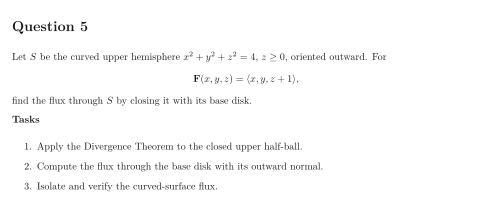
Let be the curved upper hemisphere , , oriented outward. For find the flux through by closing it with its base disk.
Tasks
Apply the Divergence Theorem to the closed upper half-ball.
Compute the flux through the base disk with its outward normal.
Isolate and verify the curved-surface flux.
Show solutionHide solution
Question 5 – Solution
Strategy. Add the base disk, compute the total closed flux, and subtract the disk contribution with careful attention to its downward normal.
Step 1: Closed flux The divergence is The upper half-ball has volume . Therefore
See the diagram in the original worksheet below.
Step 2: Base disk On , the outward normal for the half-ball is . Since there,
Step 3: Curved part Because ,
Verification On the sphere, . The radial part contributes over the hemisphere, and the constant vertical part contributes its projected area , totaling .
