Question 5
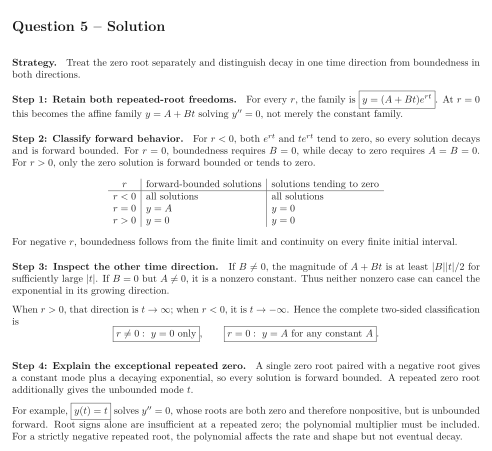
For a real parameter , consider A solution is forward bounded if bounded on and two-sided bounded if bounded on all of .
Tasks
Give the complete solution family for every real , including .
Classify exactly which solutions are forward bounded and which tend to zero as , for each sign of .
Classify all two-sided bounded solutions. Justify why a polynomial factor cannot cancel exponential growth in the growing time direction.
Explain why a repeated zero root behaves differently from a single zero root paired with a negative root. Give a counterexample to the statement that nonpositive characteristic roots always make every solution bounded.
Show solutionHide solution
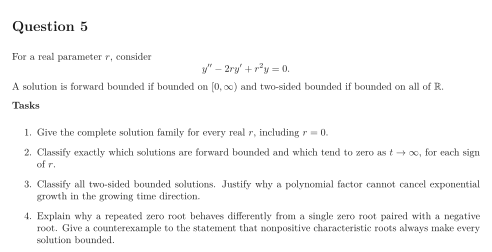
Question 5 – Solution
Strategy. Treat the zero root separately and distinguish decay in one time direction from boundedness in both directions.
Step 1: Retain both repeated-root freedoms. For every , the family is . At this becomes the affine family solving , not merely the constant family.
Step 2: Classify forward behavior. For , both and tend to zero, so every solution decays and is forward bounded. For , boundedness requires , while decay to zero requires . For , only the zero solution is forward bounded or tends to zero. For negative , boundedness follows from the finite limit and continuity on every finite initial interval.
Step 3: Inspect the other time direction. If , the magnitude of is at least for sufficiently large . If but , it is a nonzero constant. Thus neither nonzero case can cancel the exponential in its growing direction.
When , that direction is ; when , it is . Hence the complete two-sided classification is
Step 4: Explain the exceptional repeated zero. A single zero root paired with a negative root gives a constant mode plus a decaying exponential, so every solution is forward bounded. A repeated zero root additionally gives the unbounded mode .
For example, solves , whose roots are both zero and therefore nonpositive, but is unbounded forward. Root signs alone are insufficient at a repeated zero; the polynomial multiplier must be included. For a strictly negative repeated root, the polynomial affects the rate and shape but not eventual decay.