Question 3
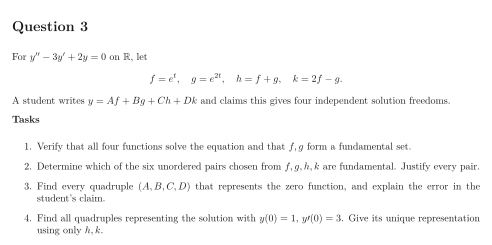
For on , let A student writes and claims this gives four independent solution freedoms.
Tasks
Verify that all four functions solve the equation and that form a fundamental set.
Determine which of the six unordered pairs chosen from are fundamental. Justify every pair.
Find every quadruple that represents the zero function, and explain the error in the student’s claim.
Find all quadruples representing the solution with , . Give its unique representation using only .
Show solutionHide solution
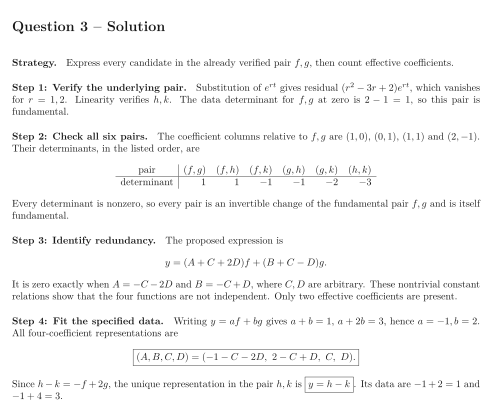
Question 3 – Solution
Strategy. Express every candidate in the already verified pair , then count effective coefficients.
Step 1: Verify the underlying pair. Substitution of gives residual , which vanishes for . Linearity verifies . The data determinant for at zero is , so this pair is fundamental.
Step 2: Check all six pairs. The coefficient columns relative to are , , and . Their determinants, in the listed order, are Every determinant is nonzero, so every pair is an invertible change of the fundamental pair and is itself fundamental.
Step 3: Identify redundancy. The proposed expression is It is zero exactly when and , where are arbitrary. These nontrivial constant relations show that the four functions are not independent. Only two effective coefficients are present.
Step 4: Fit the specified data. Writing gives , , hence . All four-coefficient representations are Since , the unique representation in the pair is . Its data are and .