Question 6
Let be independent real solutions of on an open interval , with continuous coefficients. Suppose lie in and are consecutive zeros of : and for .
Tasks
Prove that the zeros at are simple and that are nonzero.
Use the sign of the Wronskian at the endpoints to prove that and have opposite signs.
Differentiate on and use it to prove that has exactly one zero there.
Apply the result to , between and , verifying independence and finding the unique zero explicitly.
Show solutionHide solution
Question 6 – Solution
Strategy. Use the constant sign of the Wronskian first at the endpoints and then in the derivative of a ratio.
Step 1: Exclude repeated and shared zeros. If and both vanished at an endpoint, regular uniqueness would make identically zero, contrary to independence. Thus both zeros are simple. Since never vanishes, and force .
Step 2: Compare endpoint signs. Multiply by if necessary so that on . Simplicity then implies and . Abel’s identity says have the same sign. The two endpoint formulas therefore force to have opposite signs. Continuity gives at least one zero of inside.
Step 3: Prove uniqueness of that zero. On the zero-free interval for , The derivative has a fixed nonzero sign, so the ratio is strictly monotone. Its zeros are precisely the zeros of there. It can vanish at most once; combined with the preceding existence argument, this proves exactly one zero.
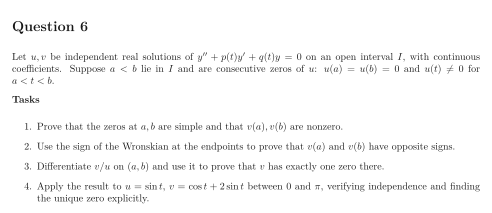
Step 4: Compute the example. Both candidates solve , and The endpoint values of are . In , the equation has its root in the second quadrant, with The separation argument proves there are no other roots between these consecutive zeros of .
See the diagram in the original worksheet below.